Monaco Grand Prix Corporate Hospitality: A Buyer's Guide
Compare Monaco Grand Prix hospitality formats by sightlines, privacy and guest experience, and plan a programme around your clients and objectives.

The most prestigious view isn’t necessarily the most effective place to host. When planning corporate hospitality at the Monaco Grand Prix, start with how your guests prefer to spend the day, the conversations you want to encourage and the impression your brand intends to leave. A trackside suite, a harbour-side setting and a dining-led experience each create a different rhythm for the weekend.
Monaco’s appeal is clear: the race, the setting and the social atmosphere make the weekend feel like a special occasion. But prestige alone doesn’t create meaningful client engagement. Guest movement, comfort and opportunities to talk all shape whether hospitality feels considered or simply spectacular.
This guide compares the principal Monaco Grand Prix hospitality formats and explains how to match a setting to your guests and commercial objectives. It also covers the practical details that bring an event together, from culinary choices and brand presence to purposeful follow-up. With more than 15 years of Formula 1 hospitality experience, AIOKA curates settings and experiences that help companies make more of a race weekend.
Key Takeaways
• Choose a hospitality setting by considering how guests will move through the event, interact and experience the race, not by prestige alone.
• Compare trackside, premium and harbour-side formats by sightlines, privacy, opportunities for conversation and atmosphere.
• Use a clear framework for Monaco hospitality planning, aligning the guest profile, brand relevance and commercial objectives.
• Plan the hosting journey from objective-setting and invitations through to event delivery and thoughtful follow-up.
• Bring curated trackside hospitality, gourmet dining and client entertaining together as a coherent experience.
Why Monaco Grand Prix Corporate Hospitality Demands a Distinct Hosting Strategy
At Monaco, hospitality is more than a way to watch the race. It is a hosted business experience in which the setting, pace and company shape the occasion as much as the on-track programme. A considered Monaco hospitality plan starts with the guests and the reason for bringing them together, then selects a setting and programme that support both.
The Circuit de Monaco winds through the principality’s close-knit urban fabric, placing the race alongside Monte Carlo’s streets, architecture and harbour. That concentrated environment gives the weekend its distinctive character, while making transitions especially important. Arrival, movement between hosted moments and time for conversation all influence the guest experience. The history and significance of the Monaco Grand Prix help explain why its appeal extends beyond the racing itself.
The Monaco setting and its influence on the guest experience
Trackside and harbour-side settings offer different ways to experience the event. Each venue has its own perspective and atmosphere, so consider the specific setting rather than assuming that a category guarantees a particular view or level of access. The 2026 race took place from 5 to 7 June. Dates for the next edition are set by the official Formula 1 calendar, so plan around the confirmed programme, since venue details and access can differ from year to year.
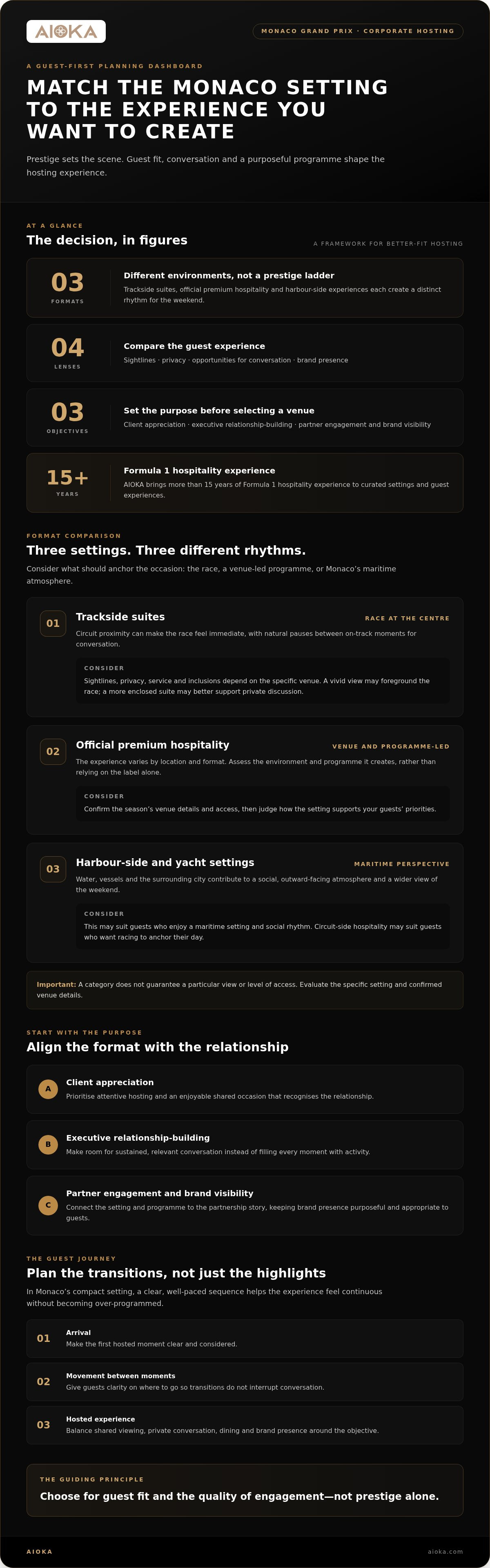
In a compact city, the transitions between hosted moments deserve as much attention as the moments themselves. A schedule that leaves guests unsure where to go can interrupt conversation. A clear, well-paced sequence gives the experience continuity without making it feel over-programmed.
Setting an objective before selecting hospitality
Define the audience and the interaction you want to encourage before choosing a format. Are you thanking existing clients, making time for senior executives or engaging partners as part of a wider brand objective? The answer helps determine the right balance of shared viewing, private conversation, dining and brand presence.
Client appreciation
Prioritise attentive hosting and an enjoyable shared occasion that recognises the relationship.
Executive relationship-building
Make room for sustained, relevant conversation instead of filling every moment with activity.
Partner engagement and brand visibility
Connect the setting and programme to the partnership story, keeping brand presence purposeful and appropriate to the guests.
Corporate hospitality at a Grand Prix is a hosted business experience designed to bring selected guests together through shared access, thoughtful service and purposeful interaction. This definition keeps the decision focused: prestige can establish the occasion, but guest fit and the quality of engagement give it direction. Set the objective first, then choose an environment that supports it and decide how you will assess the outcome afterward.
Comparing Monaco Grand Prix Hospitality Formats by Guest Experience
Think of Monaco’s hospitality formats as different environments for hosting, not interchangeable tiers of prestige. Trackside suites put the race at the centre of the occasion; official premium hospitality is shaped by its venue and programme; harbour-side experiences give the weekend a maritime perspective. When planning Monaco hospitality, compare how each setting supports sightlines, privacy, conversation and brand presence for your guests.
Trackside suites and premium circuit-side settings
Being close to the circuit can make the race feel immediate. Guests share its movement and sound, with natural pauses between on-track moments for conversation. This can suit invitees who want a strong connection to the sporting programme. But “trackside” alone doesn’t describe the experience: sightlines, privacy, service and inclusions depend on the venue.
Consider the balance your guests will appreciate. A vivid view may make the race the focus, while a more enclosed suite may better support private discussion. Official premium hospitality also varies by location and format. Judge it by the environment and programme it creates, rather than its label, and plan around the venue details and access for the season.
Harbour-side and yacht settings in the wider Monaco experience
Harbour-side hosting gives the weekend a different composition, with the water, vessels and surrounding city contributing to the atmosphere. It can create a more social, outward-facing occasion, while circuit-side hospitality keeps attention more directly on the competition. The official Monaco tourism guide offers broader destination context for considering how the principality’s setting shapes a guest’s experience.
A yacht is a distinctive venue, not a universal answer. It may suit guests who enjoy a maritime setting and a more social rhythm; circuit-side hospitality may better suit those who want the racing to anchor their day. Choose according to the interaction you want to support, not an assumption that one format is inherently more impressive. Operational and deck-hosting details are separate considerations from this high-level comparison.
Compare the options across four dimensions:
Sightlines
Decide whether the race should remain the visual focus or form part of a wider setting.
Privacy
Consider how discreet the conversation needs to be and whether the venue layout supports it.
Guest interaction
Choose between shared viewing, quieter discussion and a more social atmosphere according to the purpose of the invitation.
Brand relevance
Select an environment that complements the relationship and expresses your company’s presence with restraint.
For a broader framework covering package-selection criteria, consult this Formula 1 corporate hospitality buyer guide. AIOKA brings trackside hospitality, curated dining and client entertaining together in experiences shaped around each company’s guests and objectives. Explore AIOKA’s corporate hospitality approach to see how those elements can support a Monaco programme.
Evaluating Monaco Grand Prix Hospitality Against Corporate Objectives
A distinguished setting can create the conditions for valuable business relationships, but it cannot define success on its own. Before shaping your Monaco hospitality plans, decide what the event should make possible, who it is designed for and how your team will recognise progress. This gives the venue, programme, dining and guest communications a shared purpose.
Write down the objective and a small set of relevant indicators before sending invitations. Clarify whether the event is intended to appreciate established clients, deepen executive relationships, engage partners or express the brand in a considered way. This also gives the hosting team a basis for evaluating the experience without mistaking attendance or an enjoyable day for proof of commercial return.
Matching the experience to clients, partners and executives
Build a guest profile around the relationship, seniority, interests and likely expectations. A long-standing client may value attentive conversation and recognition; a prospective partner may benefit from time with relevant senior colleagues; an executive audience may expect a focused programme. These are planning prompts, not fixed rules, so consider each invitation in context.
Next, decide what kind of interaction best serves the group: conversation, the spectacle of the race or an immersive brand experience. One format may not suit every guest equally. If invitees have different priorities, pace the programme to include shared moments and quieter discussion. Culinary choices can help bring guests together around the table; the curated Grand Prix hospitality guide explores how dining can support a considered hosting experience.
Defining meaningful indicators of success
Connect each objective to observable signals during the event and agreed follow-through afterward. Choose indicators that reflect the intended relationship, rather than relying on general impressions.
Attendance and participation
Record who attended and whether the programme encouraged guests to engage.
Conversation quality
Note relevant discussions, introductions and shared interests without reducing nuanced relationships to a simple count.
Agreed follow-ups
Track actions accepted by either party, such as a subsequent meeting or a specific exchange of information.
Relationship progression
Review later whether the event contributed to deeper dialogue, stronger partner engagement or continued client contact.
Separate immediate observations from longer-term outcomes. Attendance, participation and conversations can be recorded at or soon after the event; commercial developments may take longer and can reflect factors beyond hospitality. A follow-up log, assigned owners and a review date help preserve context and turn promising discussions into deliberate next steps. This creates a more disciplined assessment: one that recognises the value of a well-hosted occasion without promising a return on investment.
Planning Monaco Grand Prix Corporate Hospitality from Invitation to Follow-Up
At Monaco, thoughtful planning shows in how easily guests move through the experience. For Monaco Grand Prix corporate programmes, that ease comes from aligning the objective, audience, venue and schedule early, then giving each host a clear role. A disciplined sequence keeps the occasion coherent while allowing for the race weekend’s changing rhythm.
Building a guest journey around the race weekend
Start with the intended outcome and guest profile, then shape the invitation, programme and follow-up around them. Map each touchpoint, from the first communication and arrival instructions to the welcome, shared moments, departure and next exchange. The sequence needn’t be rigid; it should be clear to guests and manageable for the team.
Before invitations go out, align the venue and programme with guest needs, dining preferences and brand considerations. Use the confirmed season schedule and venue-specific movement arrangements rather than relying on assumptions from a previous year. Build in contingency options for timing changes and communicate updates clearly rather than promising an itinerary that cannot be guaranteed.
Turning event conversations into lasting relationships
Prepare hosts to welcome, introduce and listen, instead of leaving conversation to chance. Assign responsibilities in advance: one host can greet a guest, another can make a considered introduction, and a colleague can help maintain continuity across the gathering. Brief the team on relevant relationship context and shared interests, while leaving conversations natural rather than scripted.
Capture follow-up commitments with care. Record only appropriate business details, respect guest privacy and follow your organisation’s policies for handling information. A brief note on an agreed next step is often more useful than a general impression of the event.
Set the purpose
Define the audience, intended interaction and brand considerations.
Shape the journey
Align the invitation, venue, programme and guest communications with the confirmed event schedule.
Prepare the hosts
Allocate introductions and responsibilities, and brief the team on relevant context.
Follow through
Assign owners to agreed actions and schedule a review against the indicators established before the event.
This sequence connects the race-weekend experience to deliberate relationship care, without assuming that one event guarantees a commercial result. For more principles on hosting clients across Formula 1, the Formula 1 client entertainment guide offers a broader perspective. AIOKA brings more than 15 years of Formula 1 hospitality experience to curated corporate programmes. Plan your Monaco hospitality experience with AIOKA, shaped around your guests and objectives.
AIOKA’s Bespoke Approach to Monaco Grand Prix Corporate Hospitality
AIOKA brings guest experience, business purpose and setting together in its corporate hospitality programmes. With more than 15 years of Formula 1 hospitality experience, the agency curates programmes around each company’s audience and objectives. Rather than treating hosting elements as separate decisions, AIOKA considers how they work together to deliver a coherent experience.
From access to a coherent corporate experience
Trackside hospitality can connect guests closely to the race; curated dining can create a natural setting for conversation; private client entertaining can give relationships room to develop. AIOKA brings these elements together so the venue, hosting style and culinary choices support the company’s purpose and feel connected to one another.
The right balance depends on the audience. A programme for valued clients may centre on recognition and shared enjoyment, while an executive gathering may call for more deliberate opportunities to connect. When they support the brief, brand activation or executive networking can extend the experience beyond the hosted setting, giving brand presence a considered role without letting it overwhelm the occasion.
This integrated approach is useful when planning involves several moving parts. Instead of asking guests to navigate disconnected moments, the aim is to create continuity from welcome through dining and entertaining. AIOKA shapes the atmosphere, guest experience and role of the brand around the relationships the event is designed to serve, with venue arrangements and access planned for the season.
The next step for a considered Monaco programme
Start with a concise, purposeful brief. Outline who you intend to host, what you want the gathering to facilitate, which kind of experience suits those guests and what brand priorities should guide the programme. These details give hospitality planning a clear point of view, whether the emphasis is client appreciation, relationship development or partner engagement.
AIOKA then shapes the programme around your audience and objectives, bringing trackside settings, gourmet dining and private entertaining into a coherent experience. Brand activation and executive networking can be included when they serve the brief. The result is not a promise of a particular commercial outcome, but a considered framework for welcoming guests, supporting meaningful interaction and expressing your company’s identity with discernment.
For Monaco Grand Prix corporate hospitality, the distinction lies in how well the occasion reflects both its setting and the relationships it is designed to serve. Explore AIOKA’s corporate hospitality approach and begin shaping a Monaco programme around your guests, objectives and brand priorities.
Frequently Asked Questions
What is included in corporate hospitality at the Monaco Grand Prix?
Corporate hospitality can bring together a hosted setting, trackside viewing, gourmet dining and private client entertaining, with the experience shaped by its format. When planning a Monaco Grand Prix hospitality programme, consider how each element serves your guests: dining can create time to connect, while a trackside setting keeps the race central. Brand activation can also be part of the programme when it supports the gathering’s purpose.
Is Monaco Grand Prix hospitality suitable for entertaining senior clients?
Yes. Monaco Grand Prix hospitality can provide a distinctive setting for senior-client entertainment, especially when the programme reflects guests’ interests and leaves room for considered conversation. For example, hosts can make introductions around shared business priorities rather than relying on the race to carry the interaction. Thoughtful invitations, attentive hosting and relevant follow-up help make the occasion personal. Choose a format that provides the level of privacy the relationship calls for.
How far in advance should a company plan Monaco Grand Prix hospitality?
Begin planning as early as practical. Premium hospitality and nearby hotels are often among the first options to sell out, so early planning gives companies more time to align guest lists, objectives and travel arrangements. It also helps make invitations clearer. For a future edition, build the plan around that year’s confirmed dates and venue arrangements rather than assuming they will mirror the previous season.
Can Monaco Grand Prix hospitality include a corporate brand activation?
Yes. A brand activation can be part of a corporate hospitality programme when it is relevant to the audience and appropriate to the setting. For example, a partner showcase or a considered brand moment can support the event’s purpose without interrupting guest conversation. AIOKA provides brand activation services alongside corporate hospitality, helping companies make brand presence part of the wider guest experience.
Are Monaco Grand Prix hospitality and grandstand tickets the same?
No. Grandstand tickets provide race viewing from a designated seating area, while hospitality is a hosted experience that may combine viewing with dining or client entertaining. The arrangements depend on the selected format, so don’t assume hospitality includes a particular grandstand seat or other access. Make the distinction clear in guest communications so invitees understand the nature of the occasion and what their experience involves.
How can a company measure the return on Monaco Grand Prix hospitality?
Assess the event against objectives set before invitations are sent, then distinguish immediate engagement from later business developments. For example, compare the quality of client discussions and agreed next steps with longer-term relationship or partnership progress. Record observations consistently and review them after an appropriate interval. Hospitality can contribute to commercial relationships, but a deal or revenue outcome cannot reliably be attributed to one event alone.
What should guests wear to Monaco Grand Prix hospitality?
Most hospitality venues ask for smart casual, while some of Monte Carlo’s hotel venues expect smarter attire. Guests should follow the guidance for their specific venue and event year, since requirements can differ between locations and seasons. Including dress information in the invitation helps guests prepare comfortably and appropriately.
Watch the story unfold from the paddock
Since 2012, AIOKA has hosted guests for brands like Microsoft, Marriott and Red Bull at Formula 1 race weekends. Let us plan yours.
Enquire about F1 hospitality