Luxury Brand Activation in Formula 1: Five Experience Blueprints
Luxury Brand Activation in Formula 1: Five Experience Blueprints
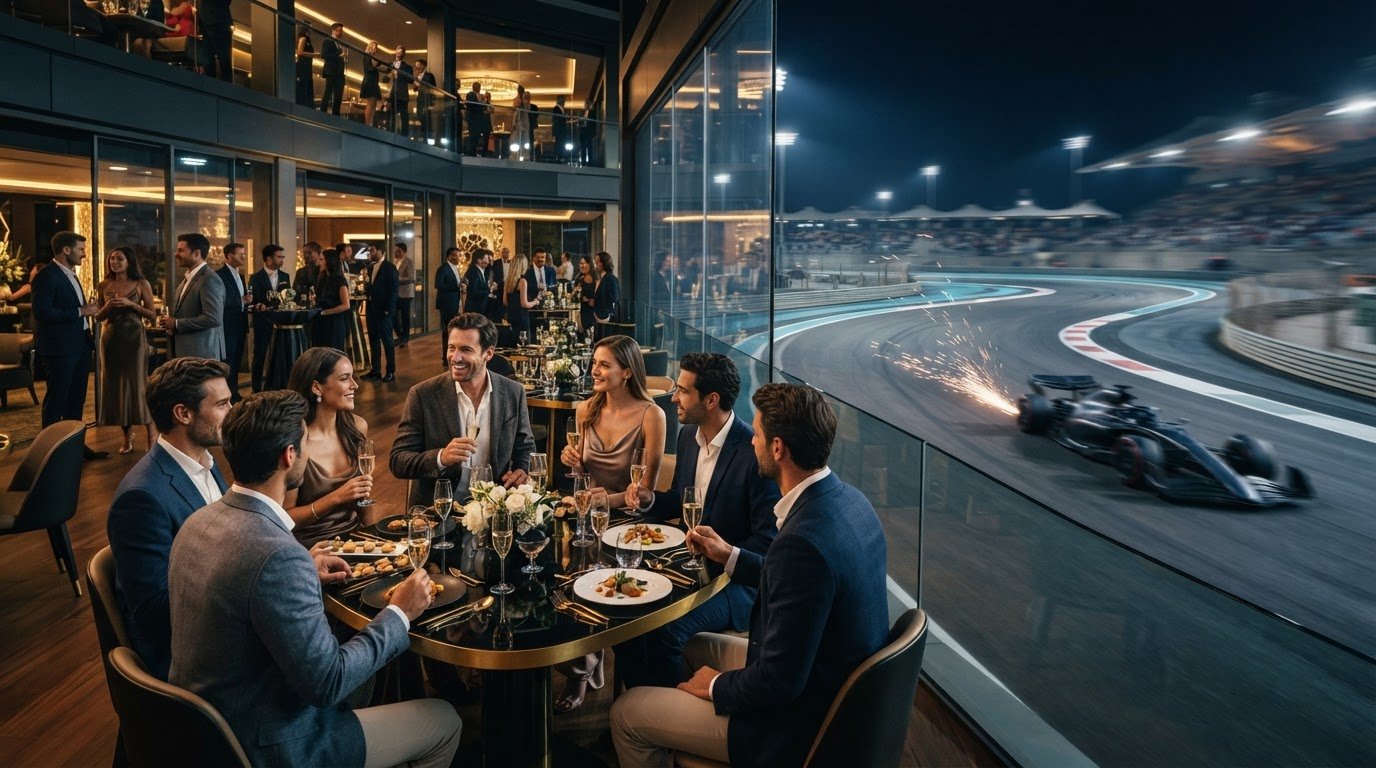
At a Formula 1 weekend, access is abundant; meaning is earned. A luxury brand activation formula 1 programme must do more than command attention: it should make every encounter feel unmistakably connected to the brand. Speed, spectacle and prestige can heighten an experience, but without a clear point of view, even an immaculate setting can feel like a display rather than the start of a relationship.
The difference lies in designing the guest journey around a business objective, from the first invitation to the conversations that continue after the race. Attendance and visibility have their place, but they do not show whether an experience strengthened trust, developed a client relationship or contributed to a commercial opportunity.
This article explores five adaptable activation blueprints. They are illustrative concepts, not documented case studies. Each shows how hospitality, sensory detail and purposeful hosting can bring a brand’s character to life within Formula 1’s scale and pace. You’ll also find a framework for assessing relationship quality and commercial contribution, so the experience is memorable and meaningful to the business.
Key Takeaways
• Build a luxury brand activation formula 1 around a defined audience and business objective, rather than relying on the race setting to supply the meaning.
• Shape the experience as a connected sequence, from objective and audience to narrative, environment and thoughtful follow-through.
• Explore five illustrative activation blueprints, each offering a distinct way to align the guest experience with brand intent.
• Assess more than attendance: distinguish operational delivery and engagement from relationship progression and commercial contribution.
• Use trackside locations, curated culinary experiences and private client hosting to support a considered activation approach.
Why luxury brand activation in Formula 1 begins with purpose, not spectacle
Formula 1 places a brand in a setting defined by pace, precision and cultural attention. Its history, sporting identity and commercial presence help explain why the championship is widely regarded as the pinnacle of motorsport. But the prestige of the setting cannot determine what a guest should take away from a brand encounter. That is the activation’s job.
A brand activation is a deliberately designed experience that invites a specific audience to engage with a brand idea; sponsorship secures association, while logo visibility makes that association seen. In a luxury brand activation formula 1 programme, the distinction matters: presence may open the door, but relevance gives guests a reason to enter, participate and remember.
What distinguishes a luxury Formula 1 activation?
Luxury is expressed through discernment as much as refinement. Discretion, craftsmanship and relevance shape how an experience feels, from the welcome and pace of hosting to the materials, food and quality of conversation. As luxury branding consultancies like Omedia Paris emphasize, each detail should reflect the brand’s established character, not a generic idea of exclusivity.
That consistency makes the guest experience feel considered rather than assembled. Premium hospitality can provide the setting and service for an activation, but it is not the whole concept. A dining experience becomes more purposeful when its setting, storytelling and hosting give guests a meaningful way to encounter the brand, rather than simply putting its name in view.
Why rare access needs a clear brand objective
Access is a resource, not an objective. A brand might use a Formula 1 weekend to deepen client relationships, create space for executive dialogue or bring a product story to life. Each purpose calls for a different audience, tone and format. A relationship-focused gathering may prioritise conversation; a product-led experience may need a tactile, guided introduction.
A clear objective gives the design team a practical standard for making choices: who should be invited, what should guests understand or experience, and what meaningful next step could follow? Without that discipline, exclusivity can attract attention without building affinity or commercial value. With it, hospitality, storytelling and service can work together as expressions of one coherent brand idea.
How to shape a luxury Formula 1 activation as one guest journey
A well-conceived activation has continuity: each encounter prepares the guest for the next, from the first invitation to the conversation that follows. An activation is a connected guest journey, not a collection of event moments. This principle gives a luxury brand activation formula 1 structure without imposing a formulaic aesthetic. The brand idea stays clear as the setting and pace shift around it.
From brand intention to an experience guests can enter
Start with a concise premise that turns a brand value into something guests can understand and experience. If the intention is craftsmanship, for instance, the narrative might invite guests to notice the choices and expertise behind a finished creation. Develop creative details once the premise gives them a shared purpose. The experience should also make sense to guests who know little about the brand or motorsport.
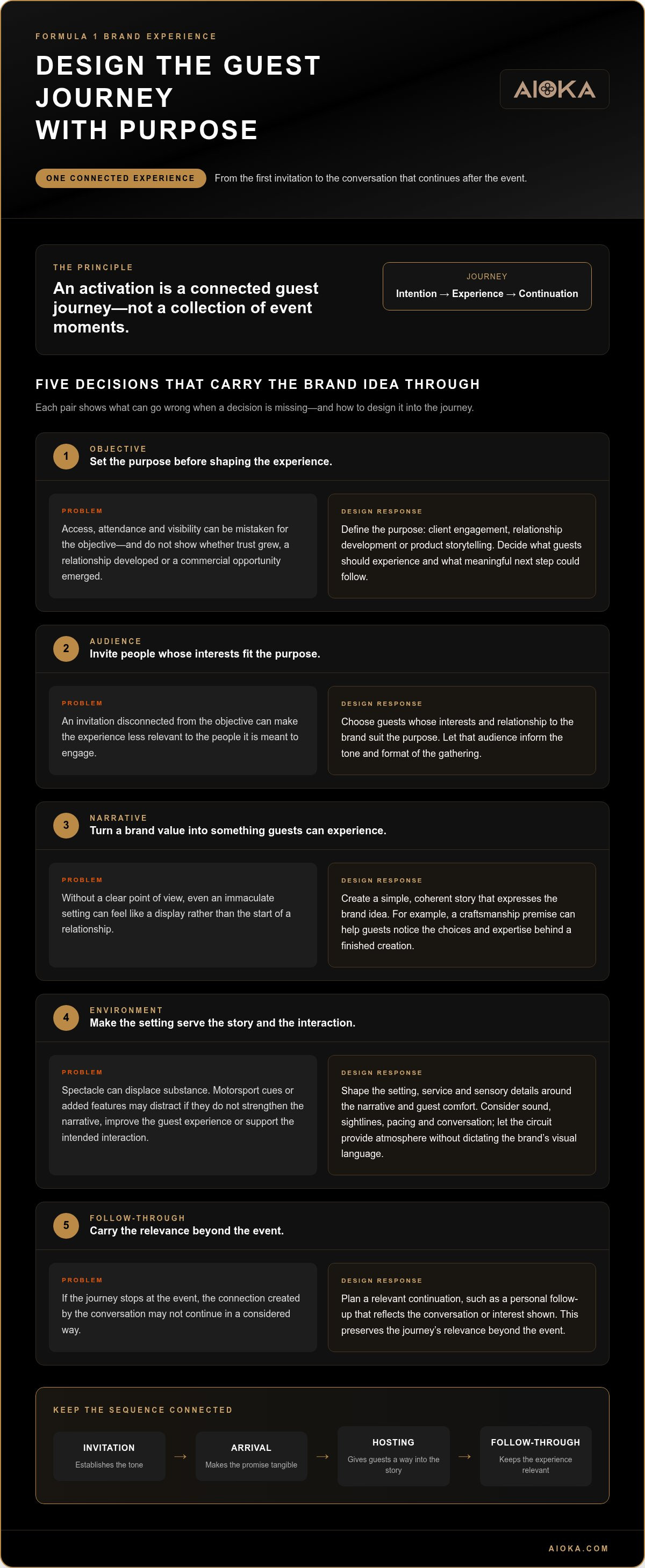
Use five connected decisions to carry that premise through the journey:
Objective
Define the purpose, such as client engagement, relationship development or product storytelling.
Audience
Invite guests whose interests and relationship to the brand suit that purpose.
Narrative
Express the brand idea in a simple, coherent story that can carry through the experience.
Environment
Shape the setting, service and sensory details to support the narrative and guest comfort.
Follow-through
Plan a relevant continuation, such as a personal follow-up that reflects the conversation or interest shown.
These decisions should inform one another. An invitation establishes the tone; arrival makes the promise tangible; hosting gives guests a way into the story; and follow-through preserves its relevance beyond the event. Coverage of luxury marketing in motorsport offers wider context for how brands are exploring the intersection of luxury and Formula 1. The same discipline applies at every scale: creative expression should remain clear, intentional and true to the brand.
Balancing Formula 1 atmosphere with brand restraint
The circuit can lend atmosphere without dictating the visual language. Rather than imitating racing graphics or filling a space with motorsport cues, consider how the setting affects sound, sightlines, pacing and conversation. A quieter moment may serve a relationship objective better than a high-energy display; a carefully framed view can evoke the occasion while keeping the brand experience composed.
Before adding a feature, ask whether it strengthens the narrative, improves the guest experience or supports the intended interaction. If it does none of these, spectacle may be displacing substance. AIOKA’s Formula 1 activation services bring experience design and executive hosting together in a considered guest experience.
Five illustrative luxury brand activation examples for Formula 1
The following concepts are illustrative blueprints, not documented AIOKA client case studies or executed campaigns. Each pairs an audience and objective with an experience idea and potential measures. They show how a luxury brand activation formula 1 can take distinct forms without defaulting to a lounge or product display.
1. The craftsmanship salon
Audience: Existing clients and design-minded prospects. Objective: Make material quality and skilled making tangible. A host or craft expert guides guests through selected materials, techniques or design details in an intimate salon setting. Potential measures include participation in the demonstration, questions asked and follow-up requests for product information.
2. The product-storytelling studio
Audience: Qualified prospects, clients or business partners. Objective: Deepen understanding of a product’s purpose and distinguishing qualities. An expert-led demonstration gives guests a close, considered encounter, followed by private conversation shaped around their interests. Track participation, expressed interests and agreed next steps, rather than relying on impressions alone.
3. The culinary narrative
Audience: Valued clients and invited guests. Objective: Use hospitality to express a brand’s relationship with provenance, craft or place. A curated meal can unfold as a discreet hosted experience, with each course or introduction contributing to a coherent narrative. Possible indicators include guest feedback, the quality of ensuing conversations and follow-up engagement.
4. The executive exchange
Audience: Senior executives, clients and selected partners. Objective: Facilitate meaningful introductions around a shared business or cultural theme. A carefully hosted discussion gives participants room to contribute, rather than turning the gathering into a sequence of presentations. Assess relevant introductions, continued conversations and mutually agreed follow-up meetings.
5. The host-city cultural salon
Audience: International clients or partners with an interest in design and culture. Objective: Connect the brand’s perspective with the character of the race destination. A conversation or small curated presentation with a local cultural focus can add context without relying on racing imagery. Consider attendance by invited guests, participation in the discussion and subsequent interest in the subject or brand.
Adapting the concept to audience and setting
Adapt each blueprint to its guests. Existing clients may value personal recognition and deeper dialogue; prospects may need a clear introduction to the brand; partners may benefit from shared exploration; senior executives may prefer a focused exchange. Setting, timing and format matter too. An intimate hosted conversation needs different pacing and sound levels from a guided demonstration, while sightlines and the circuit atmosphere can either support or distract from the idea.
Each concept needs tailored production planning and appropriate event permissions before it is realised. The aim is not to make every activation look alike, but to preserve a coherent brand character while creating an experience that feels relevant to its audience and setting.
How to evaluate luxury brand activation outcomes at Formula 1
A useful evaluation follows the purpose of the experience. It separates what was delivered from what guests did, how relationships progressed and whether the activity contributed to commercial objectives. Activity measures record what happened; evidence of business impact shows what changed as a result. This distinction keeps a luxury brand activation formula 1 from being judged by visibility alone.
Choosing measures that reflect the activation objective
Agree on measures before the event, then interpret them in context. Attendance, impressions and hosted meetings describe activity, but cannot independently establish attention, affinity or return. A meeting is useful, for example, when it advances a specific relationship; the meeting count alone does not show its value.
Operational delivery
Compare the planned experience with what was delivered, including schedule, hosting and service. This shows whether the activation was executed as intended, not whether it achieved its broader objective.
Awareness
Consider relevant reach alongside the quality of brand interaction, such as attentive participation or considered questions. Reach indicates exposure; interaction offers a more meaningful signal of engagement.
Client development
Record substantive conversations, expressed interests and agreed follow-up. Progression to a relevant next step provides stronger evidence than the number of guests hosted.
Partner engagement
Assess participation, relationship depth and subsequent collaboration. A productive exchange may be more valuable than a larger gathering with little continued dialogue.
Commercial contribution
Track opportunities that progress and their relationship to the activation, while distinguishing contribution from direct causation. Revenue attribution requires a transparent method and an agreed measurement period.
These indicators are useful for comparison only when read against the original objective. Strong delivery with limited interaction may point to a need for a different format; active participation without follow-through may reveal a gap after the event. Neither is commercial success on its own.
Turning race-weekend engagement into considered follow-through
Before the event, assign responsibility for recording consented interactions and agreed next steps. Capture useful context, such as the subject discussed or information requested, rather than collecting notes without a clear purpose. Afterward, tailor communication to those conversations: a relevant resource or personal continuation feels more considered than a generic message sent to every guest.
Review outcomes with the teams responsible for hosting and managing client relationships, so engagement can be understood alongside what happens next. AIOKA plans Formula 1 brand activations around purposeful measures and thoughtful follow-through.
Bringing a luxury Formula 1 activation to life with AIOKA
A distinctive race-weekend experience takes more than a compelling concept. Its setting, hosting, culinary detail and brand expression need to work together, so guests encounter one coherent idea rather than disconnected arrangements. AIOKA creates premium corporate hospitality and bespoke brand activations at Formula 1 race weekends worldwide, drawing on more than 15 years of experience in hospitality and activation to plan and produce considered guest experiences.
From activation concept to a composed race-weekend experience
Trackside locations can establish a sense of occasion; curated culinary experiences can shape the rhythm of a gathering; private client hosting can make room for thoughtful conversation. Their value depends on how they serve the brand’s purpose and the people invited. A bespoke luxury brand activation formula 1 should connect these elements to the intended guest experience, whether the priority is client engagement, executive networking or product storytelling.
That coherence begins before guests arrive. The invitation can set expectations and tone, the welcome can bring the premise to life, and hosting can guide interaction without making the experience feel over-directed. After the event, thoughtful follow-through can continue a conversation or respond to an expressed interest. Production decisions across these stages maintain continuity and keep the brand’s strategic intent in view.
AIOKA brings together Formula 1 hospitality, trackside locations, culinary curation and private client entertaining. In this approach, hospitality supports the activation rather than becoming its sole purpose. Each detail can be shaped around the brand’s established character and the practical needs of its audience, without using spectacle as a substitute for substance.
Planning a brand activation with AIOKA
Start with a clear brief: define the audience, the brand objective and what guests should experience or understand. Consider the interaction you want to create, the tone that reflects the brand and the next step that could give the gathering lasting relevance. These decisions provide a foundation for shaping the setting, hosting and culinary dimension into a cohesive plan.
AIOKA develops bespoke brand activation and corporate hospitality experiences for Formula 1 race weekends, including private client entertaining and executive networking. The focus is on aligning the guest journey with commercial purpose while preserving the discretion and refinement expected of a luxury brand.
To explore how AIOKA’s Formula 1 hospitality and activation expertise can support your brand’s objectives, start with the audience and experience you want to bring together.
Shape a Formula 1 experience with lasting purpose
A memorable Formula 1 activation is shaped by more than its setting. It begins with a clear objective, follows a considered guest journey and gives each interaction a reason to continue beyond race weekend. The five illustrative blueprints show how different audiences and brand intentions can guide the experience. Purposeful measurement helps distinguish attendance and visibility from relationship progression and commercial contribution.
For a luxury brand activation formula 1, the most resonant details express the brand’s character and serve the guest, whether through thoughtful hosting, a distinctive culinary experience or a setting designed for meaningful conversation. AIOKA brings more than 15 years of Formula 1 hospitality and activation experience to bespoke activations, trackside hospitality and curated culinary experiences.
Begin with your audience, your objective and the experience you want guests to remember. Explore AIOKA’s Formula 1 hospitality and brand activation expertise and shape those priorities into a composed, purposeful race-weekend experience.
Frequently Asked Questions
What is a luxury brand activation in Formula 1?
A luxury brand activation in Formula 1 is a purposeful, immersive brand experience designed for a specific audience during a Grand Prix weekend. Unlike sponsorship visibility alone, it invites guests to engage with a coherent brand narrative through the setting, hospitality and meaningful interaction. Thoughtful follow-through can extend the encounter beyond the event. The format should reflect the brand’s objectives and audience, rather than defaulting to spectacle or conspicuous branding.
How can luxury brands create a distinctive Formula 1 activation?
Begin with a clear objective and audience, then translate the brand’s values into an experience guests can understand and enter. The setting, service and sensory details should reinforce that idea, while interaction gives guests a meaningful way to engage with it. Distinctiveness comes from relevance and coherence, not simply scale, prominent branding or racing motifs. A restrained experience can feel more recognisable when every choice reflects the brand’s established character.
What are examples of luxury brand activations at Formula 1 events?
Illustrative concepts include a craftsmanship salon for clients, designed to make material quality tangible; a guided product-storytelling studio for prospects, measured through participation and expressed interest; a provenance-led culinary experience for invited guests, assessed through conversation and follow-up; or an executive exchange for partners, evaluated by relevant introductions and continued dialogue. These are concept examples, not verified AIOKA client campaigns, and none guarantees commercial results.
How do you measure the success of a Formula 1 brand activation?
Match measures to the original objective, separating operational delivery from guest engagement, relationship progression and commercial contribution. Relevant interactions can indicate engagement; qualified conversations and agreed follow-up can signal relationship progress. Attendance and impressions record exposure, but do not establish return on their own. To assess commercial contribution responsibly, document how opportunities progress and use a transparent attribution method rather than assigning revenue to the activation without evidence.
Can corporate hospitality be part of a luxury Formula 1 brand activation?
Yes. Corporate hospitality can provide the setting and service for an activation, while a defined brand idea and meaningful guest interaction give it purpose. Trackside viewing, curated dining and private client entertaining can support thoughtful hosting, but hospitality alone does not necessarily create a complete activation. The brand narrative should shape how guests are welcomed, what they experience and how the gathering supports the intended objective, whether client engagement, product storytelling or executive networking.
How far in advance should a Formula 1 brand activation be planned?
Planning time depends on the event, concept, production complexity, guest programme and relevant permissions, so there is no single lead time for every activation. Define the objective and audience early, then develop the creative direction, operational plan and post-event follow-through in sequence. AIOKA tailors planning and production to the project, aligning the guest experience with the brand’s purpose and the practical requirements of the race-weekend programme.
Watch the story unfold from the paddock
Since 2012, AIOKA has hosted guests for brands like Microsoft, Marriott and Red Bull at Formula 1 race weekends. Let us plan yours.
Enquire about F1 hospitality