
Las Vegas F1 VIP Corporate Hospitality: A 2026 Comparison for Business Hosts
How setting, access and programme structure shape Las Vegas Grand Prix hospitality in November 2026, and how to match each format to your guests.

The most prestigious address at the Las Vegas Grand Prix isn’t automatically the best setting for a business relationship. For hosts considering las vegas f1 vip corporate hospitality, the real distinction lies in how a venue’s position, viewing perspective and access shape the time guests spend together, not simply in the status suggested by its name. That distinction matters across the November 19 to 21, 2026 race weekend, when the Strip circuit gives each hospitality setting its own character.
Options can seem alike when descriptions lead with prestige, while practical differences in access and hosting style are less visible. This comparison explains how setting, access and programme structure shape the experience, and how each can suit a different guest profile or business objective. Drawing on more than 15 years of Formula 1 hospitality experience, AIOKA brings together guest experience, client relationships and brand presence in programmes designed with a clear purpose.
Key Takeaways
• Compare hospitality formats by the access and hosting flexibility they provide, not prestige alone.
• Match the experience to your guests, whether the priority is client retention, executive relationships, partner engagement or staff recognition.
• Start with a clear objective and guest profile to build a las vegas f1 vip corporate hospitality programme with purposeful business value.
• Build the weekend plan around current event schedules, transport arrangements and venue terms.
• Consider whether curated dining or a distinct brand activation could complement hospitality and strengthen the wider programme.
Las Vegas F1 VIP Corporate Hospitality: What Makes the Setting Distinctive?
VIP corporate hospitality is event access designed around the guests, the occasion and a defined business purpose. At a Grand Prix, the experience depends on more than entry: the setting, the rhythm of the weekend and the opportunities for meaningful conversation all matter. The appeal of las vegas f1 vip corporate hospitality begins with the city, but a thoughtful host also considers guest access, privacy and how the programme can support the relationship.
Las Vegas gives the race a distinctly urban character. The circuit runs through the city, and the Grand Prix takes place after dark, bringing together the spectacle of Formula 1 and the Strip’s luminous streetscape. For background on the event’s history and circuit, see the Las Vegas Grand Prix Wikipedia entry. The destination adds atmosphere, but it does not determine which hospitality setting is right for every group.
The Strip Circuit as a Corporate Hosting Environment
A street circuit woven into a major city can shape the whole weekend, from guests’ expectations of an evening event to the wider itinerary around race sessions. Hosts may need to balance a shared sporting occasion with dining, private entertaining and time for business conversation. The right format depends on how those elements fit together, not on the city’s reputation alone.
For 2026, the Grand Prix is scheduled for November 19 to 21. Before arranging a programme, review the current official schedule and event information, including session timings, circuit layout, viewing positions and access details for the selected experience. These specifics affect arrival plans and the pace of the evening, so build the itinerary around confirmed information rather than assumptions about the Strip circuit.
From Premium Attendance to Purposeful Client Hosting
Attending a race and hosting clients are related, but distinct, propositions. Attendance centres on being present for the event. A corporate programme also considers whom the host is welcoming, how guests will spend time together and what the occasion should communicate. A client-retention gathering may call for a different balance of shared spectacle and conversation than an executive meeting or partner recognition event.
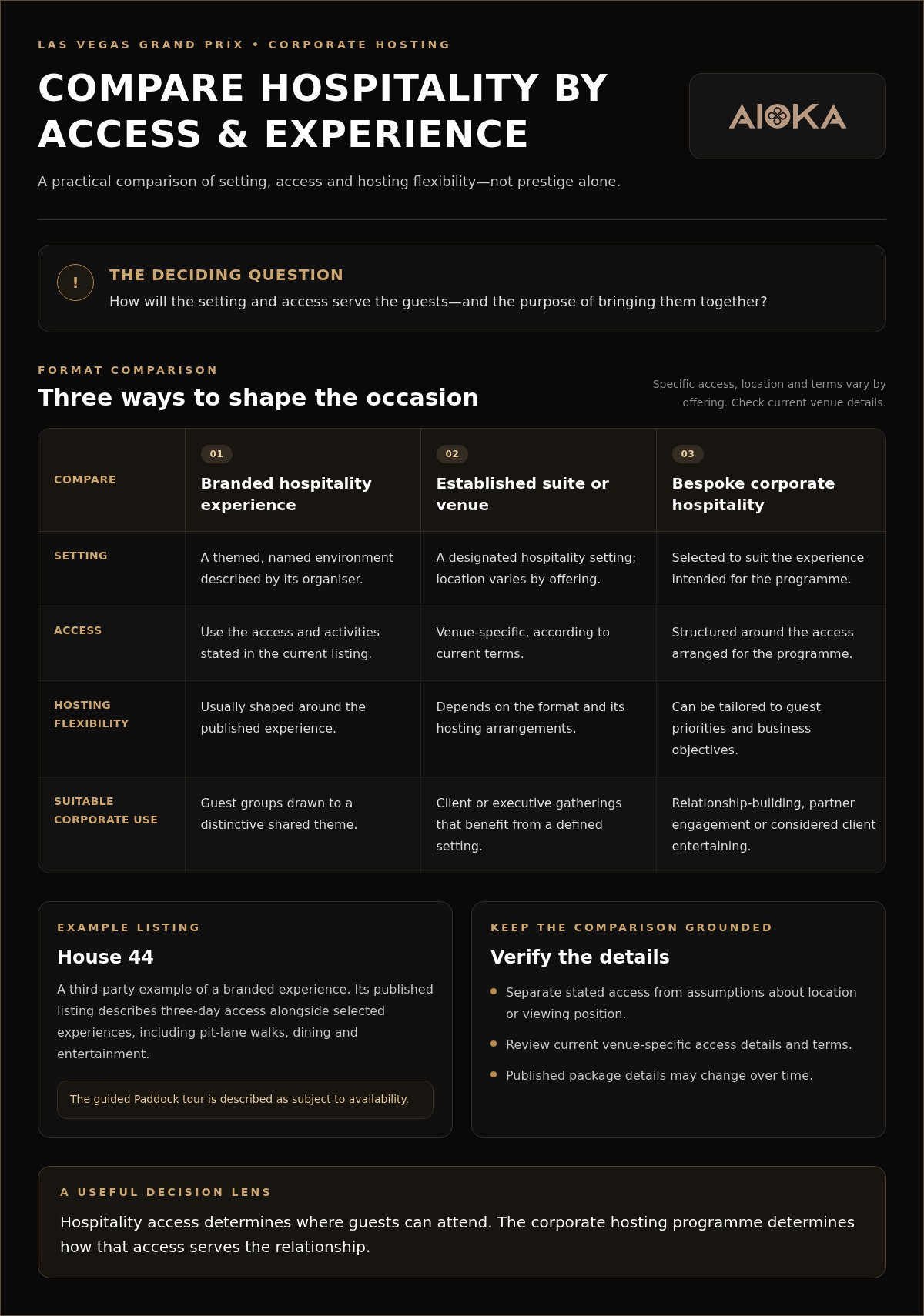
Hospitality access determines where guests can attend; a corporate hosting programme determines how that access serves the relationship. This distinction helps separate a prestigious setting from a purposeful experience. Consider the guest profile, desired level of privacy, importance of shared dining and whether brand presence should be part of the occasion. These criteria give hosts a practical way to compare formats before shaping the itinerary.
For a broader framework on evaluating objectives, guest experience and programme design across race weekends, the Formula 1 corporate hospitality strategic buyer guide provides useful context. In Las Vegas, apply the same discipline: treat the destination as one part of the decision, then align the setting and hosting approach with the reason for bringing guests together.
Comparing Las Vegas F1 Hospitality Formats by Access and Experience
Hospitality descriptions often use similar language about exclusivity, yet the experience can differ in setting, access and scope to shape the occasion. A useful comparison separates published features from the hosting choices a company can make around them. The Official F1 Las Vegas Grand Prix 2026 Guide is a reference for event information. Review venue-specific access and terms separately, using current details.
Package labels alone don’t establish corporate suitability. The decisive comparison is how the setting, access and hosting flexibility serve the guests and the purpose of the gathering.
| Format | Setting | Access | Hosting flexibility | Suitable corporate use |
|---|---|---|---|---|
| Branded hospitality experience | A themed, named environment described by its organiser | Use the access and activities stated in the current listing | Usually shaped around the published experience | Guest groups drawn to a distinctive shared theme |
| Established suite or venue hospitality | A designated hospitality setting; location varies by offering | Venue-specific, according to current terms | Depends on the format and its hosting arrangements | Client or executive gatherings that benefit from a defined setting |
| Bespoke corporate hospitality | Selected through the programme’s intended experience | Structured around the access arranged for the programme | Can be tailored to guest priorities and business objectives | Relationship-building, partner engagement or considered client entertaining |
Branded Hospitality Experiences and Established Suites
House 44 is one third-party example of a branded experience. Its published listing describes it in connection with the Paddock Club and presents three-day access alongside selected experiences, including pit-lane walks, dining and entertainment. It describes a guided Paddock tour as subject to availability. These details apply to that listing, not to other packages, and may change over time.
An established suite or venue can provide a clearly defined setting, while a branded experience gives the occasion an explicit identity. Neither is inherently the stronger choice. The useful question is whether the published format fits the guests’ expectations and the company’s intended tone. For any option, distinguish stated access from assumptions about location, viewing position or activities.
Bespoke Corporate Hospitality and Tailored Hosting
A tailored programme starts with the people being hosted and the purpose of bringing them together. AIOKA’s corporate hospitality brings together trackside locations, curated dining and private client entertaining in programmes shaped around business objectives. This approach considers the guest experience as a whole, rather than treating a package name as the programme itself.
For another destination perspective, the Monaco Grand Prix corporate hospitality buyer guide offers a useful comparison of how location informs hosting decisions. Companies considering a tailored Las Vegas programme can explore curated corporate hospitality programmes that align setting, dining and client engagement.
Choosing Las Vegas F1 VIP Hospitality for Your Corporate Objective
The right experience begins with the business purpose, not the package description. For las vegas f1 vip corporate hospitality, identify who will attend, which relationships matter and what a successful gathering would look like. A hospitality setting creates a context for conversation, but it cannot guarantee a commercial result. That depends on the relationship and how the host engages guests.
Translate the objective into practical selection criteria before comparing options:
Client retention
Prioritise a personal experience that recognises the relationship and leaves room for genuine conversation.
Executive relationship-building
Consider the balance between shared race activity and quieter opportunities for senior guests to connect.
Partner engagement
Choose a format that suits a group with varied interests and encourages interaction among attendees.
Staff recognition
Focus on a coherent group experience that reflects the occasion and makes participation feel purposeful.
Matching the Experience to Guests and Business Purpose
The guest profile shapes the right rhythm. Senior clients may value a measured programme with space for individual conversation, while partner networking may benefit from a more social environment built around a shared occasion. Before comparing hospitality descriptions, define the intended outcome in observable terms, such as strengthening an existing relationship, creating meaningful introductions or recognising a valued contribution.
Then consider the group: who knows one another, who should be introduced and whether guests are accustomed to formal entertaining. These details help distinguish a setting that is simply impressive from one that feels comfortable and relevant to its audience. The Formula 1 client entertainment guide for business hosts offers broader principles for aligning guest experience with the purpose of hosting.
Assessing Privacy, Flexibility and Brand Presence
Privacy and flexibility are different considerations. A private entertaining environment may suit confidential conversation or a closely managed guest list, while a shared or branded setting can create a more communal atmosphere. Compare the facilities and access described for each experience, and assess how its format fits the group. A prestigious label alone does not establish privacy or adaptability.
Brand presence also calls for a deliberate choice. Hospitality centres on hosting guests; a brand activation may be more appropriate when the objective is to create a visible, participatory brand experience. AIOKA’s brand activation and event production services support that broader objective, while curated dining and private client entertaining can form part of hospitality-led programmes. Plan any venue access or activation permissions according to the applicable event-specific terms.
Weigh the criteria together. A highly branded experience may suit a group seeking a distinctive shared occasion, while a tailored programme may better reflect specific guest priorities or relationship goals. The strongest choice is the one where setting, privacy, flexibility and brand role support the purpose without promising an outcome no event environment can ensure.
Planning the Las Vegas Race Weekend: A Practical Comparison Checklist
A well-planned race weekend depends on more than the hospitality setting. The guest list, session schedule, arrival plan and time between programme elements need to work together, especially in a city where the circuit sits within a wider urban environment. Use this sequence to turn the objectives for las vegas f1 vip corporate hospitality into a practical itinerary, grounded in current event information.
A Five-Step Sequence for Corporate Hosts
Define the objective.
Decide what the gathering should support, such as client retention, executive engagement, partner recognition or staff appreciation. Set a realistic measure of success, such as meaningful time with priority guests or introductions between attendees.
Shape the guest profile.
Establish who is invited, how guests know one another, whether they are expected to attend the full programme and what level of privacy would make the occasion comfortable. Use this to guide the hospitality format and itinerary.
Compare documented formats.
Review the stated setting, access, hospitality arrangements and venue terms for each option. Separate published inclusions from assumptions, and avoid treating one format as right for every guest or objective.
Build the itinerary around confirmed timings.
Set arrival, hospitality and departure windows around the sessions guests intend to attend. The 2026 event is scheduled for November 19 to 21; the published schedule lists practice and qualifying on Thursday and Friday, followed by the race on Saturday. Recheck the current official schedule before finalising plans, and use the latest session timings and event information to shape the itinerary.
Plan the follow-up.
Decide how the host will continue the conversation after the event, whether through a personal note, a subsequent meeting or an introduction agreed during the weekend. Thoughtful follow-up gives the occasion continuity without overstating what hospitality alone can achieve.
Las Vegas Logistics That Influence the Guest Experience
An urban circuit makes coordination part of the hosting design. Use current event-specific information to confirm arrival and departure points, daily access arrangements, transport plans and venue terms. Routes, access points and schedules can differ across hospitality settings. Leave suitable margins around each programme element so guests are not rushed from arrival into a session or required to leave without time to conclude conversations.
Dining and private entertaining can give the itinerary a composed rhythm, particularly when the race programme leaves intervals between shared activities. Consider where a meal or hosted conversation belongs, how much time guests need between commitments and whether the sequence feels balanced rather than overfilled. AIOKA’s corporate hospitality programmes bring trackside locations, curated culinary experiences and private client entertaining into plans shaped around business objectives.
For a race weekend designed around your guests and objectives, plan a considered corporate hospitality programme with AIOKA.
AIOKA and a Considered Las Vegas F1 Corporate Hospitality Programme
A considered programme starts with the purpose of bringing people together, then gives it form through the setting, dining and the way guests experience the occasion. AIOKA is an independent global agency with more than 15 years of experience arranging premium corporate hospitality at Formula 1 race weekends and creating brand activations. Its approach brings the elements of a programme into line with the relationships and business objectives it is designed to support.
For hosts considering las vegas f1 vip corporate hospitality, this means looking beyond a single venue or event credential. AIOKA has access to Formula 1 races worldwide and works with trackside locations, curated culinary experiences and private client entertaining. These capabilities provide a foundation for shaping an experience around the guest profile and purpose, with each programme built around its own setting and access arrangements.
From Hospitality Selection to Programme Design
Hospitality curation and brand activation can serve different briefs. A hospitality-led programme centres on welcoming clients, executives or partners through an occasion designed around their experience. A brand activation puts greater emphasis on how a company presents itself and engages its audience. AIOKA’s Formula 1 experience helps bring these approaches into consideration, with the format guided by the brief rather than a preset package.
For example, a host focused on executive networking may prioritise a thoughtful balance of shared time, dining and private client entertaining. A company seeking a more visible brand expression may include activation services alongside hospitality, with access and permissions planned according to applicable event terms. The distinction is purposeful: hospitality can nurture the guest relationship, while an activation can give the brand a more active role in the experience.
Shaping the Next Conversation
Preparation gives the planning conversation a clear starting point. Bring together the business objective, guest profile, preferred dates and a description of the experience you hope to create. Identify which relationships should receive particular attention, whether guests are expected to attend together and how dining, trackside hospitality or private entertaining might contribute to the occasion.
With these priorities established, AIOKA can shape a coherent programme that connects hospitality choices with client engagement and, where relevant, brand objectives. The value lies in how the elements work together: guests understand the purpose of the invitation, the experience feels intentional and the host has a clear framework for the weekend. No setting can promise a commercial outcome, but a well-aligned programme can create a fitting context for meaningful interaction.
For a discreet discussion shaped around your objectives, guest profile and preferred experience, discuss a Formula 1 corporate hospitality programme with AIOKA.
Shape the Race Weekend Around What Comes Next
The next decision is not simply which experience feels most prestigious, but what you want guests to carry forward from the weekend. For las vegas f1 vip corporate hospitality, a clear purpose can guide the setting, the pace of the programme and the role of the brand, so each element feels considered rather than assembled around access alone.
AIOKA brings more than 15 years of Formula 1 hospitality experience, access to races worldwide and expertise in corporate hospitality and brand activation. That perspective supports programmes shaped around guests and business objectives, whether the priority is nurturing client relationships, creating meaningful executive connections or expressing a brand with intention.
Begin with the people you plan to host, the relationship you hope to develop and the kind of experience that would feel appropriate to both. From there, a considered programme can turn an exceptional race weekend into a purposeful setting for connection. Discuss a considered Formula 1 corporate hospitality programme with AIOKA, and take the next step with clarity.
Frequently Asked Questions
Is Las Vegas F1 VIP corporate hospitality suitable for client entertainment?
Yes, when the experience reflects the client relationship and guests’ expectations. A host retaining a long-standing account, for example, might invite a small group and make room for unhurried conversation. A partner gathering may call for a more social format. The value of las vegas f1 vip corporate hospitality rests not on spectacle alone, but on thoughtful guest selection and what the host does after the event.
What is the difference between F1 Paddock Club hospitality and other Las Vegas hospitality options?
The difference depends on the specific experience’s documented setting, access and terms, not its category name alone. Compare the current listing for details such as where hospitality takes place, which event days it covers, what activities are described and whether the environment suits your group’s preferred style. A feature stated for one branded experience, including House 44, shouldn’t be assumed to apply to Paddock Club hospitality generally or to other Las Vegas options.
Can a company combine Las Vegas F1 hospitality with a brand activation?
Yes. A company can shape its programme to include both, in line with event-specific terms. Hospitality focuses on welcoming invited guests; an activation gives the brand a more visible or participatory role. For instance, a sponsor may want to host selected clients while also creating an experience that introduces a campaign. These aims call for distinct planning considerations, and any proposed activation must align with the relevant venue and event permissions.
How many days should a corporate group attend the Las Vegas Grand Prix?
There’s no single ideal duration. Choose attendance around the guests’ schedules and the purpose of the invitation. A group with limited availability might focus on one day, while a multi-day plan could suit guests whose programme benefits from more than one shared occasion. Before issuing invitations, compare the current event calendar with the documented duration of the hospitality experience, then make the expected attendance pattern clear to guests.
What should a company include in a Las Vegas F1 hospitality brief?
A useful brief records the hosting objective, intended guest list and number of invitees, preferred dates, privacy needs and any brand ambitions. Include relevant guest considerations, such as dietary requirements, accessibility needs or the amount of time they can commit, so these can inform the experience design. State which elements matter most, such as shared dining, client conversation or an activation, rather than relying on prestige as the sole selection measure.
Does Las Vegas F1 hospitality include accommodation or transport?
Not necessarily. Accommodation and transport can vary by experience, so distinguish hospitality access from travel arrangements when reviewing the current terms. For planning, identify where guests will be staying, how they expect to reach each scheduled element and who is coordinating those arrangements. Keep the itinerary flexible until event timings and access details are established, and don’t assume a hospitality description also covers hotel stays, transfers or other travel services.
How can a business assess the value of F1 corporate hospitality?
Assess value against the purpose set before the event, not attendance alone. A simple post-event review might record whether priority guests attended, which intended introductions took place, what follow-up each relationship needs and whether anyone agreed a next conversation. Note observations soon after the weekend, while details are fresh. Treat these indicators as evidence for future planning, not proof that hospitality by itself caused a commercial result.


