
Justifying an F1 Hospitality Budget to Your CFO: A Practical Business Case
How to frame race-weekend client hosting as a measurable commercial investment, with clear objectives, credible metrics and a concise memo for finance.

Prestige alone is not a business case. For executives justifying F1 hospitality budget to CFO, the challenge is to show how a race-weekend setting serves a defined commercial purpose, rather than appearing to be discretionary entertainment. The financial scrutiny is reasonable: relationship-building may influence future opportunities, but it rarely produces a clean, immediate sales figure.
A credible proposal connects the investment to specific objectives, such as strengthening priority client relationships, advancing a live opportunity or creating space for senior-level discussions. It also separates activity, including invitations accepted and meetings held, from outcomes, such as agreed next steps, pipeline movement and relationship progress. No single event guarantees revenue, but a disciplined framework makes the intended value visible and its limits clear.
This guide explains how to prepare a concise, defensible request, establish a baseline and choose measures suited to the business objective. It also sets out a practical post-race review, so the decision rests on evidence gathered before, during and after the weekend. AIOKA creates trackside hospitality experiences shaped around guest priorities and commercial objectives, helping businesses plan the hosting experience without relying on prestige alone.
Key Takeaways
• Begin with the business objective, whether that is deepening priority relationships, bringing decision-makers together or supporting account development.
• When justifying an F1 hospitality budget to a CFO, establish account and relationship baselines before the event, then select a few measures that reflect the intended outcome.
• Compare the race-weekend proposal with other options using the same audience, objective, time horizon and decision criteria.
• Assign clear owners for guest strategy, event delivery, data capture and post-event reporting.
• Turn the approved business case into a guest plan and hosting format, aligning trackside settings, curated dining or brand activation with the event’s purpose.
Justifying an F1 Hospitality Budget to a CFO: Start with the Business Objective
A sound proposal starts with the business decision the event is intended to support, not the setting, programme or prestige of race weekend. For anyone justifying an F1 hospitality budget to a CFO, the distinction is fundamental: this is a hosted business engagement, not simply a ticket purchase or a media-reach investment. Its purpose is to create a considered environment where selected guests can spend meaningful time with the organisation.
State that purpose plainly. The objective might be to deepen a priority client relationship, bring together decision-makers who are difficult to convene, or support account development at a defined stage. Identify the audience, the relevant account context and the business decision or next step the gathering is designed to enable. A useful line for the proposal is: “Hospitality creates a setting for engagement; it does not guarantee a commercial result.”
Separate Hospitality from Sponsorship and General Entertainment
Sponsorship purchases rights and visibility, so its evaluation may consider exposure, audience reach or brand association. Hospitality is different: it centres on invited guests, the quality of the hosted experience and the conversations it can make possible. General entertainment, by contrast, may have no defined commercial audience or purpose. These activities can coexist, but they need distinct objectives and measures. Sponsorship impressions alone cannot demonstrate the relationship impact of hosting.
The commercial rationale for hospitality depends on the organisation’s priorities and guest strategy. Formula One’s international profile, described in this overview of Formula One as a global sport, can provide a compelling shared context. Its scale and visibility, however, do not prove that a particular guest relationship will advance.
Translate the Experience into a Finance-Relevant Purpose
Make the connection between each guest group and a business priority explicit. For example, a proposed gathering might bring together senior stakeholders from an existing account ahead of a strategic review. The rationale would be to create time for relationship-building before that discussion, not to claim that attendance will secure a renewal. Another group might include decision-makers from several prospective accounts, with the aim of making introductions and identifying appropriate follow-up.
For each group, describe the account or relationship context, why these guests are being invited and what meaningful progress would look like afterward. Progress might mean a follow-up meeting, a clearer understanding of stakeholder priorities or agreement on a next conversation. These are indicators to assess, not promised results, and their relevance depends on the objective set before the event.
The race-weekend format should have a reason beyond prestige. A trackside setting may suit a small group of senior guests when shared time and an engaging backdrop support the planned conversation. Curated dining may provide a more measured setting for discussion. AIOKA’s Formula 1 corporate hospitality strategic buyer guide offers further context on matching the hosting format to the audience and purpose.
Keep the opening business case concise: objective, audience, account context and intended next step. This gives finance a clear basis for assessing the proposal while leaving commercial outcomes to be evaluated, not assumed.
Build a Measurable F1 Hospitality Business Case Before the Race
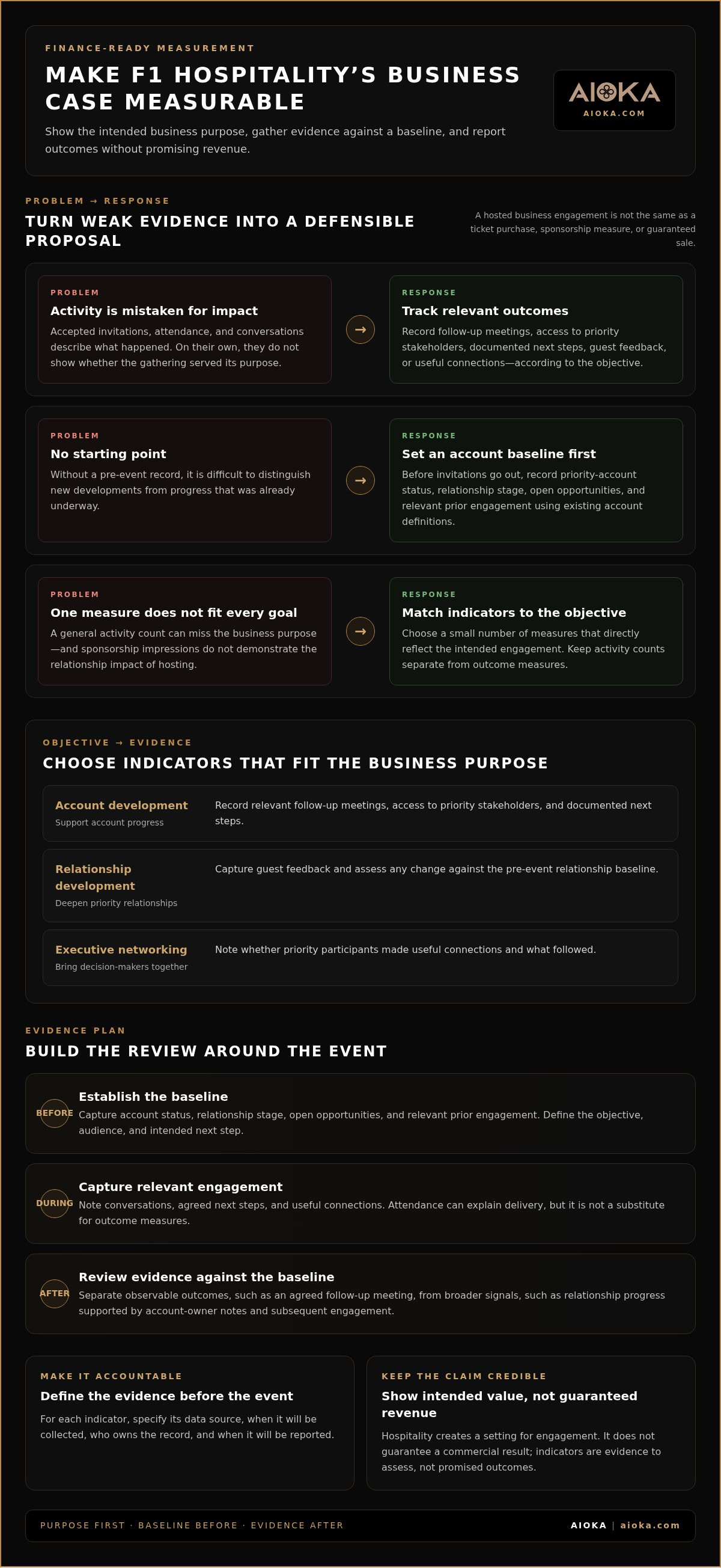
A credible measurement plan starts before invitations are sent. Record each priority account’s current status, relationship stage, open opportunities and relevant prior engagement, using the definitions already applied in your account records. This baseline gives the post-event review a point of comparison and helps distinguish new developments from progress already underway.
When justifying an F1 hospitality budget to a CFO, resist filling the report with activity counts. Attendance, accepted invitations and conversations held describe delivery, but they do not show whether the gathering served its purpose. Select a small number of indicators that correspond directly to the business objective.
Select Indicators That Match the Hospitality Objective
Choose evidence that reflects the engagement you intend to create. For account development, record relevant follow-up meetings, access to priority stakeholders and documented next steps. For relationship development, capture guest feedback and assess any change against the pre-event relationship baseline. For executive networking, note whether priority participants made useful connections and what followed.
Keep direct outcomes separate from broader signals. An agreed follow-up meeting is observable; a stronger relationship may be a longer-term signal supported by account-owner notes and subsequent engagement. Invitation numbers and attendance can help explain what happened, but they are not substitutes for outcome measures.
Make the Evidence Credible to Finance
For each indicator, specify four details in advance: the data source, when it will be collected, who owns the record and when it will be reported. A CRM entry might document a meeting agreed during or after the event; a relationship assessment might come from the account lead’s post-event review. Define what counts as a completed outcome so teams report consistently.
Label evidence according to what it supports. An observed follow-up is not the same as estimated pipeline influence, and neither should be presented as confirmed commercial results. If an outcome depends on account-team judgement, identify it as an estimate and state its basis. Use the same definitions across future events so finance can compare results on like-for-like terms.
Separate Pipeline Influence from Financial Return
Attributed pipeline is not the same as closed revenue. A hospitality event may be one of several influences on an opportunity, so assigning its full value to the event would overstate what the evidence establishes. If you calculate financial return, define the value attributed to the event, explain the attribution method and include the full programme cost using consistent accounting boundaries. Record assumptions clearly and avoid false precision.
A restrained assessment is more defensible than an impressive but unsupported figure. It shows finance what was observed, what may have been influenced and what remains uncertain, while giving future decisions a reliable evidence base. AIOKA can shape F1 hospitality around defined business objectives, connecting the hosting format with guest priorities and intended follow-up.
Compare F1 Hospitality with Other Uses of the Budget
A proposal is more persuasive when it considers credible alternatives rather than treating a race weekend as the default way to support a client relationship. For executives justifying an F1 hospitality budget to a CFO, the comparison should hold the business objective, audience, time horizon and decision criteria constant. The question is not whether a race weekend is universally superior, but whether it is the right setting for the account strategy.
Compare the proposed experience with options such as a smaller hosted gathering, another client event or reallocating the funds to a different account-development activity. Assess each against the same factors: its ability to bring the intended guests together, the depth of engagement it may support, the relevance of the setting, the evidence that can be collected and the complexity of delivery.
Build a Like-for-Like Comparison
Use a concise comparison for each option, capturing its objective, target audience, full cost categories, expected outputs and evidence plan. Include the hospitality package, any brand activation or event production, travel where applicable, and internal time or resources. Apply the same accounting boundaries to every alternative so one option does not appear more efficient simply because its supporting costs are missing.
F1 hospitality
Note the intended guest group, hosting format, delivery requirements, expected engagement outputs and how they will be recorded.
Smaller hosted gathering
Assess whether a more intimate setting can reach the same decision-makers and allow suitable time for the planned conversations.
Another client event or reallocation
Describe the audience and purpose, then identify the relevant outputs and evidence available for comparison.
Keep expected outputs, such as attendance or follow-up discussions, separate from projected commercial outcomes, such as potential pipeline influence. Outputs describe what the activity may produce directly; commercial projections depend on assumptions and should not be presented as established results. AIOKA’s Formula 1 race weekend client entertainment guide can help frame the practical distinctions between hosting formats and guest experiences.
Answer the Objection That Hospitality Is Discretionary
Hospitality is a discretionary investment and should be assessed against competing priorities. A defensible proposal acknowledges this, then identifies the relationship, decision or business opportunity the experience is intended to support. Explain why alternative formats may be less suitable for that audience or objective. Do not rely on prestige as evidence or imply that a distinctive setting guarantees a commercial result.
State the recommendation in measured terms: this option is preferred because its guest format and setting align with the account strategy, and its costs and intended outputs can be reviewed against comparable alternatives. AIOKA creates corporate hospitality experiences shaped around business priorities, bringing together trackside settings, curated dining and bespoke brand activations. This gives finance a clear basis for evaluating the proposal, including what the business is choosing not to fund.
Prepare the Measurement Plan and CFO Decision Memo
A strong case for justifying an F1 hospitality budget to a CFO makes approval and evaluation part of the same process. Set the sequence before the event so each stage produces information the next one can use:
• Establish the account and relationship baseline.
• Document the intended guest group and hosting plan.
• Record engagement and relevant follow-up.
• Review outcomes against the original objective and agreed definitions.
Assign an owner to each responsibility: guest strategy, event delivery, data capture and post-event reporting. Before invitations are issued, agree with finance how direct outcomes, relationship signals and influenced opportunities will be classified, including the limits of attribution and the reporting date.
Use a Concise CFO-Ready Memo Structure
Open with the decision required, business objective, intended audience and why the event format suits that purpose. Then present the total investment categories, alternatives considered, key assumptions and material risks. Keep the rationale focused on the account strategy rather than the event’s prestige, and distinguish expected outputs from guaranteed commercial results.
Decision and rationale
State the approval requested, objective and guest context.
Investment and alternatives
Summarise relevant cost categories, options assessed and assumptions.
Evaluation
Name the selected indicators, their owners, the review date and the decision finance is being asked to make.
Make the rule explicit: Define success before invitations are issued, then report outcomes against that definition. This prevents the evaluation criteria from shifting after results are known and gives finance a stable basis for reviewing the proposal.
Make the Post-Event Review Useful for the Next Decision
At the agreed review point, compare actual results with the baseline and original objective. Present completed activity, observed relationship changes and commercial results as separate categories. Add context when an outcome is still developing, and label any estimate or influenced opportunity accordingly. A concise account of what happened, what the evidence supports and what remains uncertain is more useful than a single headline figure.
Close with a practical recommendation for future planning: identify what to retain, adjust or discontinue. If a particular guest profile led to relevant follow-up, record that learning. If an intended connection did not take place, consider whether the guest plan or format should change. To align the hosting experience with the business case from the outset, plan your F1 corporate hospitality around clear objectives.
Shape the F1 Hospitality Experience Around the Approved Business Case
Once the investment is approved, design the experience from the business objective outward. Do not build it around a format simply because it is familiar or prestigious. Translate the agreed purpose into a practical brief that identifies priority guests, relevant accounts, relationship stage, intended conversations and follow-up. This keeps guest selection, hosting design and post-event activity aligned with the case presented to finance.
For teams justifying an F1 hospitality budget to a CFO, this alignment matters: the event plan should reflect the approved rationale in its details. A small group of senior account stakeholders may call for private client hosting and ample time for conversation. A broader gathering may benefit from a different guest journey or a considered brand activation. The format should serve the audience and objective, not act as evidence of value in itself.
Match the Experience Design to the Intended Outcome
Consider guests’ expectations, the relationship stage and the kind of interaction the business hopes to encourage. A trackside setting can provide a distinctive shared context; curated dining can shape a more focused hosting occasion; brand activation can give guests a tangible way to engage with the organisation. Each element should have a clear role in the brief. An elevated experience alone does not guarantee a commercial result.
Build the guest journey around the purpose, from the welcome and hosting format to the intended follow-up after race weekend. The curated culinary hospitality at the Grand Prix guide offers perspective on how dining can contribute to a considered hosting approach. The central test is whether each design choice supports the intended conversation and audience.
Make the Approval Decision Clear and Actionable
Bring the request back to a concise decision: why this experience suits the approved objective, what the organisation will invest in and which evidence will inform its evaluation. Name the internal stakeholders accountable for guest selection, account context, event delivery, data capture and follow-up. Then state the planning sequence and agreed review point. This clarity helps prevent responsibility from dissolving between teams once the event is underway.
Objective and audience
Confirm the priority relationships and the purpose of hosting.
Experience and delivery
Specify the appropriate setting, culinary elements or activation, and accountable owners.
Evaluation
Use the CFO-approved indicators and report outcomes without turning estimates into promises.
AIOKA brings more than 15 years of experience securing trackside locations and curating hospitality experiences, providing relevant delivery context as the brief moves from commercial intention to event design. That experience supports considered execution; it is not evidence of guaranteed ROI. For a discussion grounded in your objectives, discuss an F1 hospitality brief with AIOKA.
Turn the Approved Case into a Considered Hosting Brief
Carry the CFO-approved objective into the experience itself, keeping the guest list, setting and follow-up connected to the decision the organisation intends to support. Justifying an F1 hospitality budget to a CFO does not end with approval; the business case also sets a standard for how the event is planned and assessed.
AIOKA brings more than 15 years of experience securing trackside locations and curating hospitality, alongside access to Formula 1 race weekends worldwide. Its corporate hospitality and bespoke brand activation services can be shaped around the audience and purpose of the brief, with the experience designed to support engagement rather than promise a commercial outcome.
With a defined objective and evaluation framework in place, planning can move from whether hospitality belongs in the budget to how a particular race weekend might serve the organisation’s priorities. Discuss an F1 hospitality brief with AIOKA to develop an approach for your guests, business objectives and intended follow-up. A well-framed brief gives your team a confident foundation for the next decision.
Frequently Asked Questions
How do you justify F1 hospitality to a CFO?
Justifying an F1 hospitality budget to a CFO starts with a defined business objective and a specific guest group, such as senior stakeholders from an account approaching a renewal discussion. State the decision requested, full cost categories and a credible alternative, then explain how engagement will be recorded and reviewed. Agree on the review date before the event. In the memo, distinguish documented meetings from pipeline influenced by the event and revenue actually closed.
What is a credible way to measure the ROI of F1 hospitality?
A credible ROI assessment requires an evidenced financial outcome, an attribution method finance accepts and consistent accounting of programme costs. If an opportunity advances after a hosted meeting, for example, document the event’s contribution alongside other sales activity rather than assigning the full opportunity value to hospitality. If financial value cannot be isolated defensibly, report agreed engagement measures and influenced pipeline separately, without manufacturing a percentage return.
Can client hospitality generate measurable business outcomes?
Yes. Client hospitality can support measurable business outcomes when the guest experience is tied to a business purpose and followed by relevant action. For example, a guest may raise a concern about a current project during a conversation, giving the account team a useful topic for a later meeting. Record the interaction and resulting follow-up, then assess them alongside the relationship’s prior status. The event may contribute, but it cannot by itself establish causation or guarantee a sale.
What should an F1 hospitality budget proposal include?
An F1 hospitality budget proposal should give finance enough context to assess both the request and its limits. Include the decision sought, business purpose, guest profile, investment categories and rationale for the chosen format. Add the alternative that would be most relevant if the event were declined, then name the evidence source and person responsible for each measure. Flag assumptions separately so projected commercial benefits are not mistaken for confirmed results.
How should I respond if a CFO says the budget is discretionary?
Acknowledge that it is a discretionary investment, then explain why the proposed format may suit this audience and objective better than the alternatives considered. Make the trade-off tangible: a smaller gathering may allow more focused conversation, while a race-weekend experience may bring selected stakeholders together in a distinctive shared setting. State what evidence would support continuing or changing the approach. A measured proposal is more credible than a promise of guaranteed returns.
Is F1 hospitality the same as F1 sponsorship?
No. Hospitality centres on hosting invited guests, while sponsorship generally involves rights, brand association and exposure. That distinction matters when reviewing results: a media-reach figure may describe sponsorship visibility, but it does not establish the value of a client conversation. A hospitality review might document whether priority guests attended and whether relevant follow-up took place. Assess each investment according to its own purpose rather than using one activity’s measures to justify the other.


