Formula 1 Private Suites: Hosting at the Highest Tier in 2026
Formula 1 Private Suites: Hosting at the Highest Tier in 2026
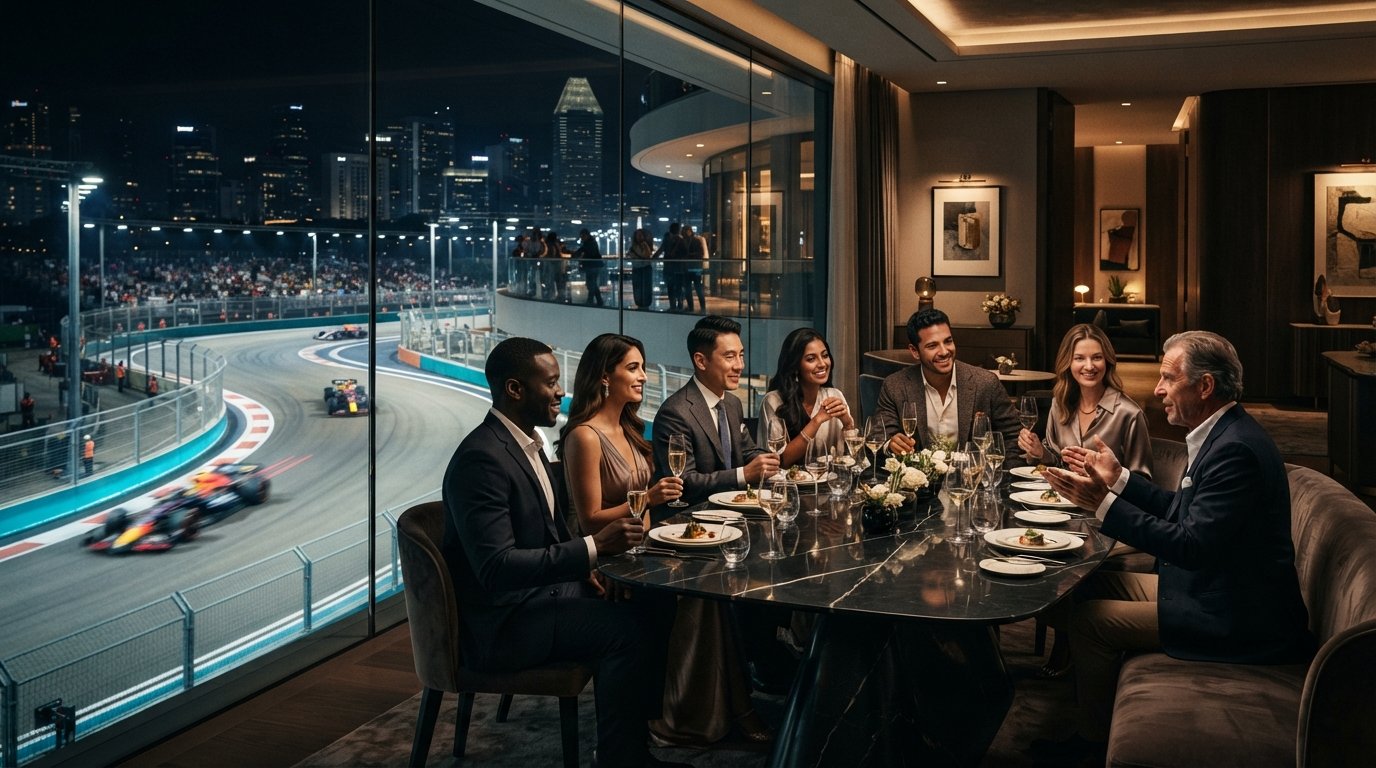
The most defining commercial partnerships in modern motorsport aren't secured amidst the noise of a shared paddock; they're forged behind sound-attenuated glass in sovereign trackside enclosures. While standard hospitality delivers exhilarating vantage points, dedicated formula 1 private suites transform race weekends from passive spectating into instruments of enterprise diplomacy. When hosting key partners, institutional investors, or executive leadership teams, the distinction between an oversubscribed shared lounge and an autonomous, secure sanctuary represents the difference between mere entertainment and strategic commerce.
You already know that orchestrating high-stakes client dialogue requires complete acoustic discretion, impeccable culinary timing, and effortless spatial authority. Yet discerning between standard multi-brand lounges and true private compounds can prove challenging across a fragmented global calendar. This guide outlines how to evaluate, structure, and maximize dedicated trackside suites to safeguard your firm's brand equity. Ahead, we examine sovereign spatial curation, interior acoustic standards, and global circuit considerations to ensure your corporate hosting achieves flawless execution at the highest tier.
Key Takeaways
• Discover how dedicated formula 1 private suites function as sovereign enterprise sanctuaries, replacing crowded hospitality tiers with total privacy and controlled access.
• Explore the spatial architecture of dual-zone suite layouts, pairing high-adrenalin trackside viewing balconies with sound-attenuated executive lounges for boardroom-level conversations.
• Compare the distinct strategic advantages of private trackside buyouts versus collective Paddock Club lounges to protect your organization's brand equity.
• Learn the fundamentals of curating multi-day culinary pacing, sommelier selections, and discreet hospitality protocols aligned with high-stakes race weekend schedules.
• Evaluate structural and geographic differences across the global championship calendar to select the optimal permanent facility or prestigious street circuit enclosure.
Defining the Private Suite Tier in Formula 1 Hospitality
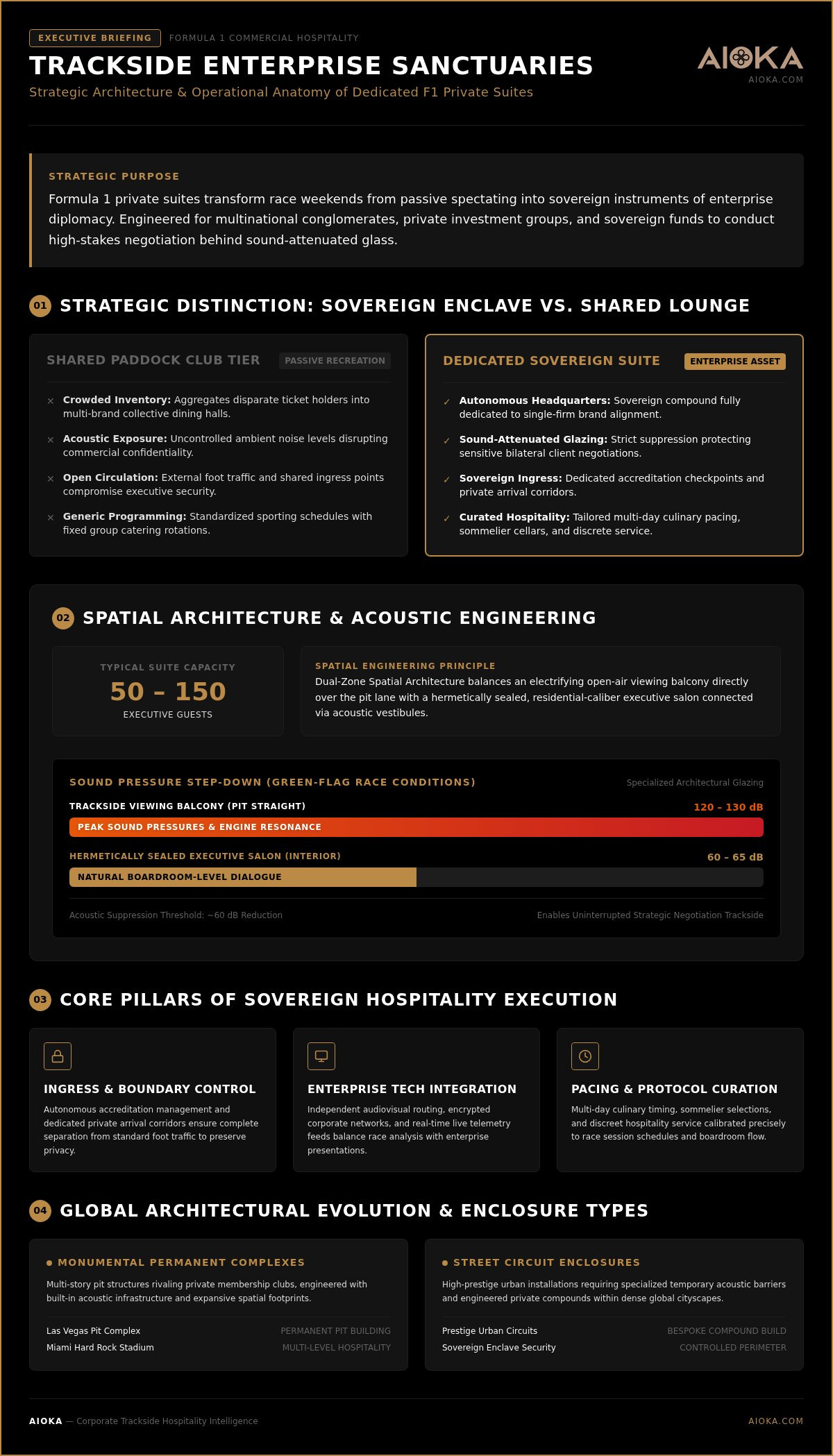
At the apex of motorsport entertainment, formula 1 private suites represent far more than premium spectator inventory; they serve as sovereign enterprise sanctuaries. Where commercial hospitality products aggregate disparate ticket holders into collective dining halls, a dedicated private suite functions as an autonomous corporate headquarters trackside. Commissioned by multinational conglomerates, private investment groups, and sovereign funds, these environments are engineered for high-stakes negotiation, proprietary brand alignment, and discreet bilateral dialogue beneath the halo of world championship racing.
Operating at this tier requires a fundamental shift in perspective. Rather than purchasing hospitality as passive recreation, enterprise hosts deploy these spaces as strategic assets, deliberately orchestrating an environment where acoustic insulation, bespoke service pacing, and executive discretion take precedence over standard sporting access.
The Evolution of Elite Paddock and Pit-Building Sanctuaries
The transformation of trackside architecture mirrors the global economic elevation of the sport itself. What began decades ago as utilitarian pit garages with modest rooftop viewing platforms has evolved into monumental, multi-story architectural complexes. Permanent structures, exemplified by the expansive pit building in Las Vegas and the multi-level hospitality facilities at Miami's Hard Rock Stadium, now rival the world's finest private clubs.
As Grand Prix weekends have coalesced into pivotal summits for international commerce and technology, the demand for insulated, sovereign spaces has accelerated. Global enterprises no longer view race weekends simply as entertainment; they treat them as strategic platforms for executive convening.
Core Architectural Criteria of Sovereign Hospitality
To qualify as a genuine enterprise enclave rather than a shared hospitality tier, trackside enclosures must fulfill rigorous spatial and operational standards:
Absolute Ingress and Boundary Control
Sovereign spaces require dedicated accreditation management and private arrival corridors, ensuring that external foot traffic cannot compromise guest privacy.
Dual-Atmosphere Demarcation
The interior architecture must balance high-energy trackside viewing balconies directly over the pit lane with hermetically sealed, climate-controlled executive salons designed for uninterrupted business conversations.
Enterprise Technology Integration
Facilities demand independent audiovisual routing, secure private networks, and dedicated telemetry feeds, allowing hosts to balance competitive track analysis with corporate presentations.
This architectural separation guarantees that while guests enjoy unfettered proximity to the pit apron, sensitive strategic discussions remain uncompromised.
Spatial Architecture and Operational Anatomy of a Private Trackside Suite
Executing an elite hospitality program requires balancing raw motorsport drama with executive productivity. Achieving this balance depends entirely on spatial engineering. Within dedicated formula 1 private suites, interior layouts reconcile two contrasting environments: an electrifying open-air viewing platform and a calm, residential-caliber salon. Designing these footprints for typical allocations of 50 to 150 guests requires careful planning across circulation paths, acoustic thresholds, and technical infrastructure.
Acoustic Zoning, Interior Lounges, and Trackside Terraces
Acoustic management serves as the cornerstone of functional corporate hosting. While the pit straight generates peak sound pressures of 120 to 130 decibels during green-flag running, specialized architectural glazing steps interior sound levels down to approximately 60 to 65 decibels. This acoustic suppression transforms the climate-controlled lounge into an environment suited for natural, conversational dialogue. Guests can step outside onto tiered viewing balconies to experience the visceral thrill of tire changes and full-throttle acceleration, then return through acoustic vestibules into an insulated space where high-level commercial discussions continue without strain.
Immersive Audio-Visual Infrastructure and Race Telemetry
Modern enterprise guests expect technical parity with team command centers. Advanced suites replace standard television displays with custom low-latency video walls, integrating multi-channel FOM broadcast feeds, real-time timing matrices, and pit-to-car radio audio streams. Before morning practice sessions begin, integrated audio-visual systems transition into presentation modes for closed-door keynote addresses and board briefings, delivering seamless commercial utility before track action commences.
Custom Architectural Branding and Bespoke Environments
High-tier enclosures allow enterprises to replace generic hospitality aesthetics with tailored architectural identity. Bespoke wood finishes, discrete brand activation elements, and variable architectural lighting allow the suite to adapt seamlessly from daylight running to dramatic nocturnal competition. Behind these public-facing areas, concealed service passages let hospitality personnel deliver fine dining courses and cellar service without interrupting client meetings. For organizations seeking tailored environmental curation, collaborating with specialists in bespoke corporate hospitality packages ensures every design detail reflects enterprise prestige.
Dedicated Private Suites Versus Shared Paddock Club Lounges
The Formula 1 Paddock Club remains globally renowned, hosting over 150,000 corporate and VIP guests across a championship season. For an enterprise convening board members, institutional partners, or strategic targets, the communal nature of shared club lounges introduces clear operational compromises. Shared hospitality gathers disparate ticket holders into open, high-density dining areas. In contrast, dedicated formula 1 private suites establish sovereign autonomy, transforming open social spaces into protected corporate enclaves.
Evaluating Discretion, Privacy, and Relationship Building
Shared lounges inevitably place corporate hosts alongside industry competitors, market analysts, and third-party attendees. Sensitive conversations regarding capital allocation, pending mergers, or proprietary technical initiatives remain vulnerable to casual observation in communal environments. Sovereign trackside suites eliminate this risk through strictly governed perimeters. With dedicated door security, credential verifications, and controlled access corridors, enterprise leadership can conduct confidential commercial dialogue with complete peace of mind. For international dignitaries and corporate principals, this physical perimeter provides the security required for serious enterprise diplomacy.
Tailored Curation Versus Standardized Event Service
Spatial independence unlocks total operational authority over hospitality cadence, culinary pacing, and daily programming. Shared facilities inevitably adhere to fixed schedules and communal dining formats designed to service hundreds of guests simultaneously. A dedicated private enclosure completely decouples the enterprise host from these institutional constraints.
Access Governance
Communal lounges permit general pass-holder circulation, whereas private suites enforce sovereign guest lists with bespoke hospitality protocol.
Gastronomic Execution
Standard formats utilize shared dining stations, while private suites deploy dedicated culinary teams, private sommeliers, and synchronized multi-course table service.
Agenda Sovereignty
Collective hospitality follows rigid circuit timetables, while private enclosures allow hosts to structure presentations, private toasts, and partner negotiations on their own terms.
This operational control ensures that the weekend unfolds around strategic enterprise milestones rather than the rigid rhythms of shared public hospitality.
Curating the Executive Experience: Gastronomy, Cellars, and Protocol
High-tier hospitality succeeds or fails on the precision of its execution. While communal paddock lounges rely on standardized service schedules, dedicated formula 1 private suites transform weekend dining into an intentional gastronomic showcase. Entertaining key institutional investors, global partners, and executive boards requires a culinary cadence synchronized with on-track action. The objective is never merely to feed guests, but to deliver a seamless sensory narrative that respects both the competitive schedule and critical business conversations.
Haute Cuisine Curation and Multi-Course Trackside Dining
Executing multi-course fine dining during live Grand Prix sessions demands extraordinary operational timing. The kitchen choreography must align perfectly with race strategy. Lighter courses appear during free practice warmups, while substantial, plated tasting menus are presented between competitive running sessions to prevent distraction during key moments. Rather than standard buffet service, dedicated private suites utilize allocated culinary teams to prepare dishes that celebrate local circuit terroirs alongside international contemporary gastronomy, accommodating individualized dietary nuances without friction.
Sommelier Cellars and Curated Mixology Programs
Beverage programs within private enclosures demand elevated sophistication. As Formula 1's multi-year luxury partnership with LVMH features Moët & Chandon across official hospitality environments, sovereign suites elevate these offerings through vintage collections, Grand Cru Champagne allocations, and temperature-controlled cellars. On-site sommeliers manage precise wine pairings, while master mixologists design artisanal cocktail menus and elevated, cold-pressed zero-proof options. This refined curation ensures every guest preference is accommodated with equal consideration.
Guest Diplomacy and Relationship Stewardship
Managing high-net-worth attendees and international dignitaries trackside requires seasoned diplomatic protocol. Behind-the-scenes concierges coordinate scheduled pit lane walks, access transitions, and private departures without leaving guests stranded in paddock crowds. Unobtrusive service staff anticipate requirements effortlessly, ensuring conversations flow naturally without transactional interruptions. To implement hospitality programs that reflect this standard of prestige, partner with AIOKA to curate bespoke culinary experiences and private hospitality for your executive delegation.
Global Circuit Profiles and Strategic Considerations for Suite Selection
Selecting the optimal Grand Prix venue demands strategic alignment between circuit architecture and corporate hosting objectives. Across the 24-round global calendar, physical infrastructure varies considerably. Evaluating formula 1 private suites requires understanding how permanent motorsport facilities differ from temporary metropolitan circuits, as each venue delivers distinct advantages for guest logistics, executive attendance, and bilateral networking.
Iconic Street Tracks Versus Modern Purpose-Built Circuits
Permanent facilities such as Yas Marina Circuit in Abu Dhabi, Circuit of the Americas in Austin, and the Bahrain International Circuit provide expansive, purpose-built infrastructure. These complexes feature vast pit-building footprints, dedicated subterranean service arteries, and expansive suite dimensions that readily support complex technical builds and high-capacity presentations.
Conversely, historic street venues present an entirely different proposition. In Monaco, where tight geography relocates traditional hospitality toward the Rascasse harbor complex and private terrace enclosures, maritime proximity creates peerless prestige at the expense of footprint scale. Nocturnal street circuits like Singapore and Las Vegas leverage central urban settings, placing executive guests alongside luxury hotel corridors and international culinary hubs.
Strategic Alignment: Matching Corporate Objectives to Grand Prix Venues
Strategic enterprise hosting relies on aligning venue selection with commercial territory priorities:
Regional Market Engagement
Select venues that coincide with core geographic client hubs, utilizing European fixtures like Silverstone or Monza for legacy relationships and Middle Eastern or Asian rounds for emerging market expansion.
Nocturnal Schedule Advantages
Night races across Singapore, Bahrain, and Las Vegas free daytime hours for closed-door executive symposiums, transitioning effortlessly into trackside evening hospitality.
Access and Transport Infrastructure
Permanent tracks offer superior airfield transit and dedicated circuit helicopter corridors, whereas street tracks excel in direct pedestrian proximity to luxury accommodation.
Securing Dedicated Private Suites with AIOKA
Procuring sovereign trackside architecture requires deep institutional relationships rather than transactional ticket brokers. Securing prime pit-building placements, coordinating complex interior millwork, and managing regulatory credentials require extensive advance planning and multi-season lead times. Backed by over 15 years curating ultra-premium trackside private enclosures, corporate hospitality packages, and bespoke brand activation programs across the world championship calendar, AIOKA orchestrates sovereign Grand Prix hosting for global enterprise leaders with effortless precision.
Mastering Sovereign Hospitality on the World Stage
Sovereign trackside enclosures redefine the nature of corporate entertainment. When high-stakes enterprise relationships demand boardroom-grade acoustic discretion, tailored architectural prestige, and synchronized fine dining, dedicated formula 1 private suites provide an incomparable commercial platform. They safeguard confidentiality and foster genuine stakeholder intimacy while immersing your guests in the electrifying heart of motorsport competition.
Orchestrating an engagement of this magnitude requires deep institutional access and flawless operational poise. Backed by over 15 years curating private enclosures, brand activations, and curated culinary experiences across the global championship calendar, AIOKA ensures every detail reflects your enterprise stature. Explore bespoke trackside suite curation with AIOKA and elevate your next Grand Prix weekend into a defining corporate milestone.
Frequently Asked Questions
What is the primary difference between a private suite and the Formula 1 Paddock Club?
The primary difference lies in operational sovereignty and occupancy control. While the standard Paddock Club gathers hundreds of guests into communal lounges and dining areas, formula 1 private suites offer dedicated enterprise sanctuaries. A sovereign suite provides private door security, customized branding, confidential meeting zones, and dedicated culinary staffing, insulating your executives and guests from shared public foot traffic throughout the Grand Prix weekend.
How many guests can a dedicated Formula 1 private trackside suite accommodate?
Dedicated private trackside suites typically accommodate delegations ranging from 50 to 150 attendees. At premier permanent circuits and bespoke street venues, layouts can be tailored to match specific organizational footprints. Suites often feature partitioned boardrooms, private bars, and exterior viewing terraces, allowing hosts to manage large corporate groups while maintaining comfortable spatial flow and conversational intimacy throughout each session.
Can a corporation customize the branding and interior architecture of an F1 suite?
Yes, full architectural and visual customization is a hallmark of dedicated corporate suites. Enterprise hosts can replace neutral hospitality aesthetics with proprietary wall coverings, custom millwork, bespoke lighting schemes, and branded presentation stages. Incorporating dedicated audiovisual arrays for keynotes, executive product showcases, and interactive partner activations transforms the suite from a standard venue into a seamless physical extension of your corporate brand.
What access privileges accompany private suite credentials during a Grand Prix weekend?
Private suite credentials provide dedicated circuit parking, expedited VIP ingress corridors, all-day suite access, and scheduled pit lane walks throughout the race weekend. While suite badges grant seamless movement across the hospitality complex, they don't automatically grant entry into the working team paddock or active team garages behind the pit boxes. Those specialized experiences require constructor allocations or specific elevated access tiers coordinated in advance.
Are dedicated private suites available at every race on the 2026 Formula 1 calendar?
Private hospitality configurations exist across the entire 2026 championship calendar, though structural forms differ by destination. Modern permanent circuits like Austin, Bahrain, and Abu Dhabi feature purpose-built pit-building suites. In contrast, street circuits utilize specialized architectural enclosures, such as multi-level temporary complexes in Las Vegas and Miami or private harborfront terraces and yachts in Monaco, requiring tailored planning for each territory.
How does catering and beverage curation operate within a private corporate suite?
Catering within formula 1 private suites operates independently of communal buffets. Hosts work alongside dedicated culinary teams and master sommeliers to design bespoke multi-course menus synchronized with track schedules. Service includes allocated waitstaff, Grand Cru Champagne reserves, fine cellar pairings, and artisanal cocktail bars. Dietary preferences and executive presentation timings are orchestrated seamlessly to avoid disrupting high-stakes commercial discussions.
How far in advance must an enterprise secure a private trackside suite?
Enterprises should initiate suite procurement six to twelve months prior to the race weekend. Securing prime pit-building positions requires early engagement because top-tier inventory is limited and frequently retained through multi-year enterprise agreements. Securing placement well in advance also provides the essential runway required to design custom architectural finishes, coordinate complex guest accreditation, and finalize bespoke gastronomic programs.
Watch the story unfold from the paddock
Since 2012, AIOKA has hosted guests for brands like Microsoft, Marriott and Red Bull at Formula 1 race weekends. Let us plan yours.
Enquire about F1 hospitality