Formula 1 Experiential Marketing Agency: A Case Study in Trackside Impact
What a Formula 1 experiential marketing agency does, how a trackside programme comes together, and how to measure it credibly.
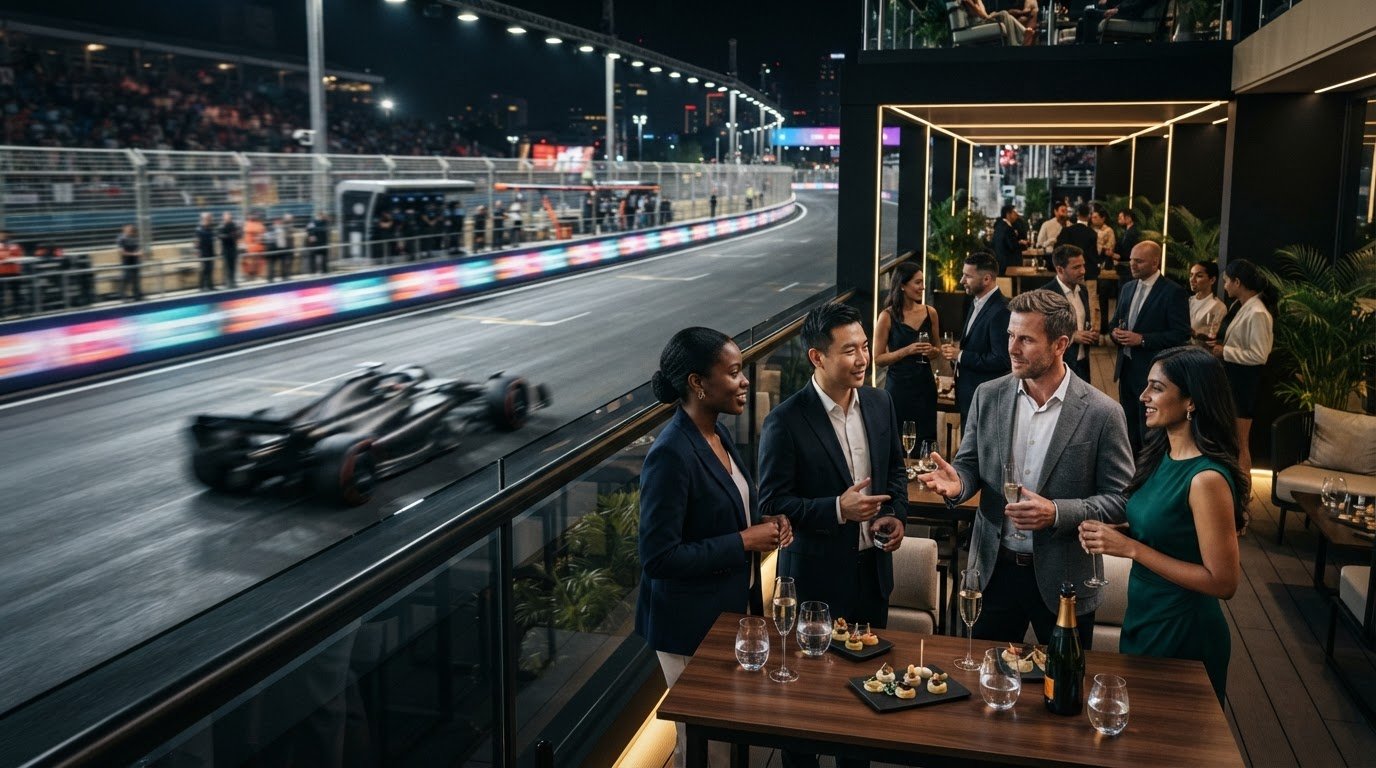
A premium trackside setting can open the door to valuable conversations, but it cannot define what a brand achieves on its own. A formula 1 experiential marketing agency earns its value by connecting business objectives to a purposeful guest experience, then setting out how to evaluate that experience.
For marketing leaders, premium access is compelling, but its commercial contribution can be hard to separate from spectacle. Race-weekend delivery adds complexity: creative intent, hospitality, partner presence and guest relationships must work together in a demanding live environment.
This article explores how AIOKA, an independent luxury hospitality and brand activation agency with more than 15 years of experience and access to Formula 1 races worldwide, brings brand activity and premium hospitality together for a considered race-weekend experience. It looks at the agency’s role in strategy, creative development and delivery, and how trackside activity can support defined audience and business objectives.
It also considers practical measures, from guest engagement and qualified follow-up to relationship progression, while distinguishing documented outcomes from claims that cannot be substantiated. The result is a useful framework for aligning purpose, execution and measurement over a race weekend.
Key Takeaways
- Distinguish sponsorship rights, hospitality and live activation so each element has a clear role in the brand experience.
- Plan in sequence, from business objective and audience to creative concept, delivery and evaluation.
- A considered formula 1 experiential marketing agency connects trackside access with an intentional guest journey instead of treating visibility as the outcome.
- Separate event outputs, such as attendance, from business outcomes, such as qualified engagement and relationship progression.
- Assess a global programme through its strategic coherence, creative quality, trackside delivery and approach to measurement.
Formula 1 experiential marketing: why the agency role goes beyond visibility
A Formula 1 weekend brings live competition, corporate hospitality and international attention into a concentrated setting, while the circuit environment gives brands the opportunity to create personal encounters. Within the wider discipline of sports marketing, an agency translates a brand objective into a coherent experience, rather than simply arranging a presence beside the track.
A brand activation is a designed interaction that gives an audience a purposeful way to encounter a brand. A sponsorship right grants defined association or visibility. It may enable an activation, but it is not the activation itself. Hospitality creates a setting for hosting and relationship-building, while event production manages the practical creation and operation of an event. These elements can work together, but each serves a different purpose.
From sponsorship presence to an active brand experience
Logos and signage offer exposure: guests can see a brand without engaging with it. An activation invites a more deliberate encounter, perhaps through a partner showcase, a curated culinary experience or a setting designed to prompt conversation. Its value depends on the relevance of the interaction to the audience and the brand’s purpose, not on activity for its own sake.
Sponsorship rights can provide association, access or a platform for brand activity, subject to the rights secured. They create an opportunity; experiential design determines how that opportunity becomes meaningful to guests. A formula 1 experiential marketing agency connects the two by shaping the experience around a defined objective, rather than treating visibility as the measure of success.
The agency’s role across a Grand Prix weekend
The work starts with strategy: clarifying the objective, intended audience and role of the experience. Creative direction gives those decisions a distinctive form, while production planning and on-site coordination bring the concept into the event environment. Each stage needs to support the others, so the guest experience feels considered and the practical details are well managed.
Hospitality can support an activation by creating space for hosted conversations, private executive networking and deeper engagement. It does not have to be the programme’s only purpose. The balance depends on the brief, the rights in place and the selected setting. With more than 15 years of experience, access to Formula 1 races worldwide and expertise in trackside locations, AIOKA brings hospitality and brand activation together in a race-weekend experience.
From business objective to trackside experience: the Formula 1 activation process
A compelling trackside experience begins well before a guest arrives. A formula 1 experiential marketing agency translates a business priority into a clear creative and delivery framework, so the setting, guest journey and hospitality all serve a deliberate purpose. A useful sequence is objective, audience, concept, delivery plan and evaluation, with each decision guiding the next.
A business objective becomes actionable when it is translated into a live experience designed for the people the brand needs to reach.
Setting the brief, audience and measure of success
Start by deciding what the programme is intended to do and who it is for. A brand seeking to strengthen client relationships may need a different guest journey from one introducing a product or encouraging qualified engagement. Make the objective specific enough to guide creative decisions, while grounding it in the audience’s needs and the Grand Prix context.
Build evaluation into the brief. Before delivery, agree which indicators to record and how they relate to the objective. Attendance describes an event output; by itself, it does not demonstrate relationship progression or commercial impact. A case study should distinguish intended outcomes from measures that were tracked, documented and linked to the experience.
Shaping the concept and delivering it trackside
With the brief in place, creative direction can give the brand’s purpose a tangible expression. Choose a trackside location that supports the intended interaction, and plan guest flow so participation feels natural rather than imposed. The atmosphere and dining can reinforce the experience and create room for conversation without becoming its sole reason for being.
The delivery plan aligns the concept with the event environment, production requirements and relevant partner roles. AIOKA’s work includes securing exclusive trackside locations and curating activations, alongside bespoke corporate hospitality, gourmet dining and partner showcases. These capabilities can be combined to suit the brief. A case study should describe project outcomes only when they are documented.
A credible case study follows the same discipline: describe the verified objective, audience, concept and delivery, then report only learning and measures supported by project records. This keeps the account specific without turning an elegant setting into an unsupported claim of business success. AIOKA’s Formula 1 brand activation and hospitality work brings these strategic and experiential considerations into one programme.
Inside a Formula 1 experiential marketing case study: connecting access, hospitality and activation
A useful case study explains how an experience was shaped, not just what a race weekend looked like. It follows a clear line from project context and business objective to creative concept, delivery and documented learning. That sequence shows how access and hospitality served the brief, while keeping claims about impact proportionate to the evidence.
The project context and experiential concept
Begin with the event environment and intended audience, then describe the client challenge using details supported by project records. A relationship-building brief, for example, calls for a different experience from one centred on product understanding. These are possible objectives, not assumptions to assign to a specific activation. Explain how the concept expressed the brand’s purpose in the setting, and distinguish AIOKA’s contribution from the roles of the client, rights holders and other partners.
AIOKA’s Formula 1 work encompasses trackside locations, curated activations, bespoke corporate hospitality, gourmet dining, partner showcases and private executive networking. These capabilities provide context for the agency’s approach. Describe them as part of a particular project only if they were delivered together for that project. This distinction makes the account more precise and credible.
The guest journey and execution details
Trace the experience from invitation or arrival through its central interaction and hosted moments. Explain how the setting, movement through the space, dining or partner presence supported the intended encounter, using details attributable to the project. The design of the journey and the connection between hospitality and brand interaction often say more than a catalogue of event features.
For a formula 1 experiential marketing agency, execution is part of the case, not a footnote. Describe the agency’s documented role in shaping and delivering the experience, and identify rights-holder or partner responsibilities accurately. If project results are confidential, focus on verified delivery and learning rather than implying numerical success or unsubstantiated commercial impact.
Use images, quotations and other artefacts only when their use is approved. Apply the same care to conclusions: distinguish what the team delivered, what guests experienced and what the evidence supports. A case study built on that distinction gives readers a more useful view of trackside work than an impressive setting alone.
Measuring Formula 1 experiential marketing beyond impressions
A beautifully composed setting can shape a guest’s memory, but it cannot establish commercial impact on its own. Start measurement with the objective: what was the experience designed to change, for whom, and what evidence could reasonably show progress? A formula 1 experiential marketing agency should help define this relationship before the event, not build a success story after the fact.
Attendance shows who was present; it does not prove that the event generated commercial return. Attendance, invitations accepted and interactions delivered are useful outputs. They describe the scale and operation of an experience, but not whether guests understood a product more clearly, had a meaningful conversation or moved a business relationship forward.
Choosing indicators that reflect the original objective
Choose measures that match the brief, and distinguish what was intended from what was recorded. Depending on the objective, relevant indicators might include:
- Awareness: documented reach or recall measures, where they formed part of the evaluation.
- Engagement: recorded participation, substantive conversations or completed product demonstrations.
- Relationships: qualified follow-up, agreed next steps or documented progression in a client relationship.
- Business development: opportunities or pipeline movement linked to the event through a defined tracking process.
These are possible indicators, not assumed results for a particular activation. Documented post-event follow-up can add useful context, especially when it records whether a conversation continued and what action followed. A guest count alone cannot provide that evidence.
Interpreting results with appropriate attribution
Evidence varies in strength. Participant feedback can indicate how guests perceived an experience, but it does not independently prove a commercial outcome. A follow-up meeting after the event may suggest a contribution. A documented opportunity linked to the activation offers a clearer, though still bounded, account of influence.
Attribution requires care when a sales cycle is long or other channels, partner activity and existing relationships also shaped the outcome. Report what the records support, identify relevant limitations and avoid assigning the entire result to one event without evidence. This is more credible than an unsupported return-on-investment figure or a promise that attendance will convert into business.
AIOKA can align trackside hospitality and brand activation with the objectives and measures established for a programme. Discuss a Formula 1 activation programme designed around purposeful experiences and credible evaluation.
Choosing a Formula 1 experiential marketing agency for a considered global programme
A global programme calls for more than event access. A formula 1 experiential marketing agency should connect the business brief to a distinctive guest experience, then coordinate the people and practical requirements needed to deliver it. Evaluate five related disciplines: strategy, creative, access, production and measurement.
- Strategy: Does the agency translate the business objective and intended audience into a clear experience brief?
- Creative: Does the concept express the brand’s priorities in a way that feels relevant to guests and the race-weekend setting?
- Access: Can the agency shape the programme around appropriate trackside locations and event environments?
- Production: Can creative intent, hospitality and partner roles come together in a coherent delivery plan?
- Measurement: Do the proposed indicators connect to the original objective, with outcomes distinguished from attendance and other outputs?
Assessing strategic and creative alignment
Access has value when it serves a well-defined purpose. The agency should understand what the brand wants guests to experience, what those guests need from the interaction and how the concept can express the brief without feeling incidental to the event. A partner showcase, for instance, should have a clear role in the guest journey rather than functioning as a decorative addition.
AIOKA brings strategic brand activity and premium hospitality together. Assess a project through its documented decisions, including the objective, audience and creative choices, rather than through assumed outcomes or unsupported details.
Coordinating access, hospitality and delivery
Trackside location, curated dining and guest hosting can each contribute to a joined-up experience while retaining distinct roles. A hospitality setting can create the conditions for executive conversation; an activation gives guests a purposeful way to engage with the brand. Their relationship should follow the brief, rather than being collapsed into one measure of success.
AIOKA is an independent luxury hospitality and brand activation agency with more than 15 years of experience, access to Formula 1 races worldwide and expertise in securing exclusive trackside locations and curating activations. Its work brings bespoke corporate hospitality, gourmet dining and brand activity together in a programme shaped around the brief and event environment.
For brands seeking a partner to align creative intent with trackside delivery, explore AIOKA’s Formula 1 experiences.
Shape a more purposeful presence at the next Grand Prix
The value of a trackside experience starts with a clear business objective, continues through a guest journey designed around that purpose and becomes more credible when outcomes are measured carefully. Attendance and visibility describe exposure. Qualified engagement and relationship progression can offer deeper insight when they are documented and appropriately attributed.
A considered formula 1 experiential marketing agency aligns strategy, creative development and delivery, so access and hospitality support the brand experience rather than stand apart from it. AIOKA brings more than 15 years of experience, access to Formula 1 races worldwide, and expertise in trackside locations and curated luxury brand activations.
For organisations looking to connect premium hospitality with purposeful brand activity, explore AIOKA’s Formula 1 experiences and discuss a considered race-weekend programme.
With a clear objective, thoughtful execution and credible evaluation, a Grand Prix programme can create a meaningful setting for brand engagement and lasting business relationships.
Frequently Asked Questions
What does a Formula 1 experiential marketing agency do?
A Formula 1 experiential marketing agency turns a brand objective into a live experience and coordinates its strategy, creative development and delivery. This can involve shaping an activation, selecting a suitable trackside environment, coordinating production and integrating guest hospitality where it supports the brief. The agency’s role is broader than arranging visibility: it designs how guests encounter the brand and helps define appropriate ways to evaluate the experience.
How can Formula 1 experiential marketing create value for a brand?
Formula 1 experiential marketing can create value by giving audiences a purposeful way to engage with a brand in a distinctive live setting. A well-designed experience might support product understanding, encourage qualified conversations or provide a considered environment for client relationship-building. The value depends on how closely the concept serves the business objective and audience. Access or attendance alone does not establish commercial impact; evaluation should reflect documented engagement and follow-up.
What is the difference between F1 sponsorship and experiential marketing?
F1 sponsorship provides defined rights or association with the sport, a team or an event, while experiential marketing designs an interaction through which people encounter a brand. Sponsorship may create a platform for activity, but logo placement is exposure rather than an experience in itself. An activation could use an appropriate partner showcase or hosted setting to make the brand’s purpose tangible. The opportunity depends on the rights secured and the event environment.
How do you measure the success of an F1 brand activation?
Measure success against the activation’s original objective, using indicators that were agreed and recorded. Attendance and participation describe outputs; qualified engagement, documented follow-up or relationship progression may indicate outcomes when evidence supports them. Separate participant feedback from demonstrable business contribution, and account for other channels or long sales cycles that influence results. Do not present attendance as proof of return or claim that a single activation caused a commercial outcome without clear attribution.
What happens during a Formula 1 brand activation?
A Formula 1 brand activation moves from a defined business objective and audience to a concept, delivery plan and evaluation approach. On the event weekend, guests encounter the experience in a setting selected for the brief, with production and coordination supporting the intended interaction. The format varies and may include a partner showcase, curated culinary elements or hosted conversations. Each element should have a clear role rather than being included for spectacle alone.
Can corporate hospitality be part of experiential marketing at a Grand Prix?
Yes. Corporate hospitality can complement a brand activation by providing a considered setting for guest hosting, dining and conversation. Its role is distinct: hospitality creates the environment for hosting, while activation gives guests a purposeful interaction with the brand. When aligned to the brief, the two can form a coherent experience that supports client relationships without treating hospitality itself as proof of marketing impact. AIOKA provides corporate hospitality experiences at Formula 1 race weekends.
How should a brand choose a Formula 1 experiential marketing agency?
Assess whether the agency can connect strategy, creative, access, production and measurement to the same business objective. Look for a clear approach to audience definition, guest experience, partner coordination and evaluation, alongside relevant trackside experience. AIOKA is an independent luxury hospitality and brand activation agency with more than 15 years of experience, access to Formula 1 races worldwide and expertise in trackside locations and curated activations. Evaluate project claims against documented details.
Watch the story unfold from the paddock
Since 2012, AIOKA has hosted guests for brands like Microsoft, Marriott and Red Bull at Formula 1 race weekends. Let us plan yours.
Enquire about F1 hospitality