
F1 races for corporate entertaining, from historic wins to championship deciders
Which Grands Prix make memorable client occasions, from celebrated comebacks to title deciders, and how to plan travel and hospitality around your choice.

The best F1 races for corporate entertaining include the 2011 Canadian Grand Prix, the 2010 Abu Dhabi Grand Prix and the 2024 São Paulo Grand Prix, ranked first, second and third respectively in Formula 1’s 2025 greatest-races countdown. Each offers a different lens on the sport’s history, from dramatic victories to championship-defining moments, giving you a meaningful starting point for selecting a race weekend.
The occasion matters as much as the circuit: a celebrated comeback gives guests a story to share, while a championship decider lends the weekend a sense of consequence. Choosing with those distinctions in mind helps align the race with your gathering, whether you are welcoming clients, strengthening relationships or creating a distinctive setting for business conversation. This guide explores historic Grand Prix victories and pivotal drivers’ and constructors’ championship moments, then considers how to weigh each race’s character when planning corporate entertaining. You’ll find a shortlist of races whose sporting significance can shape an experience with both atmosphere and purpose.
Key Takeaways
• Choose a race weekend by the sporting story you want guests to experience, whether a historic victory or a championship-defining contest.
• Plan travel, accommodation and transfers as part of the event design, since each can shape the ease and flow of the guest experience.
• Weigh Formula 1 against other sporting occasions by considering its distinctive combination of competition, hospitality and relationship-building potential.
• Align the hospitality setting, brand presence and culinary experience with the purpose of the gathering and the guests you intend to bring together.
When should companies book F1 hospitality and corporate event packages?
A championship decider is a Grand Prix that can settle a drivers’ or constructors’ title. A historic victory is a race remembered for a defining performance or result. Choose the moment that best serves the gathering, then align the event plan with the relevant race weekend. Formula 1 had held 1,131 Grand Prix events by the time the shortlist was prepared, so sporting significance offers a useful first filter.
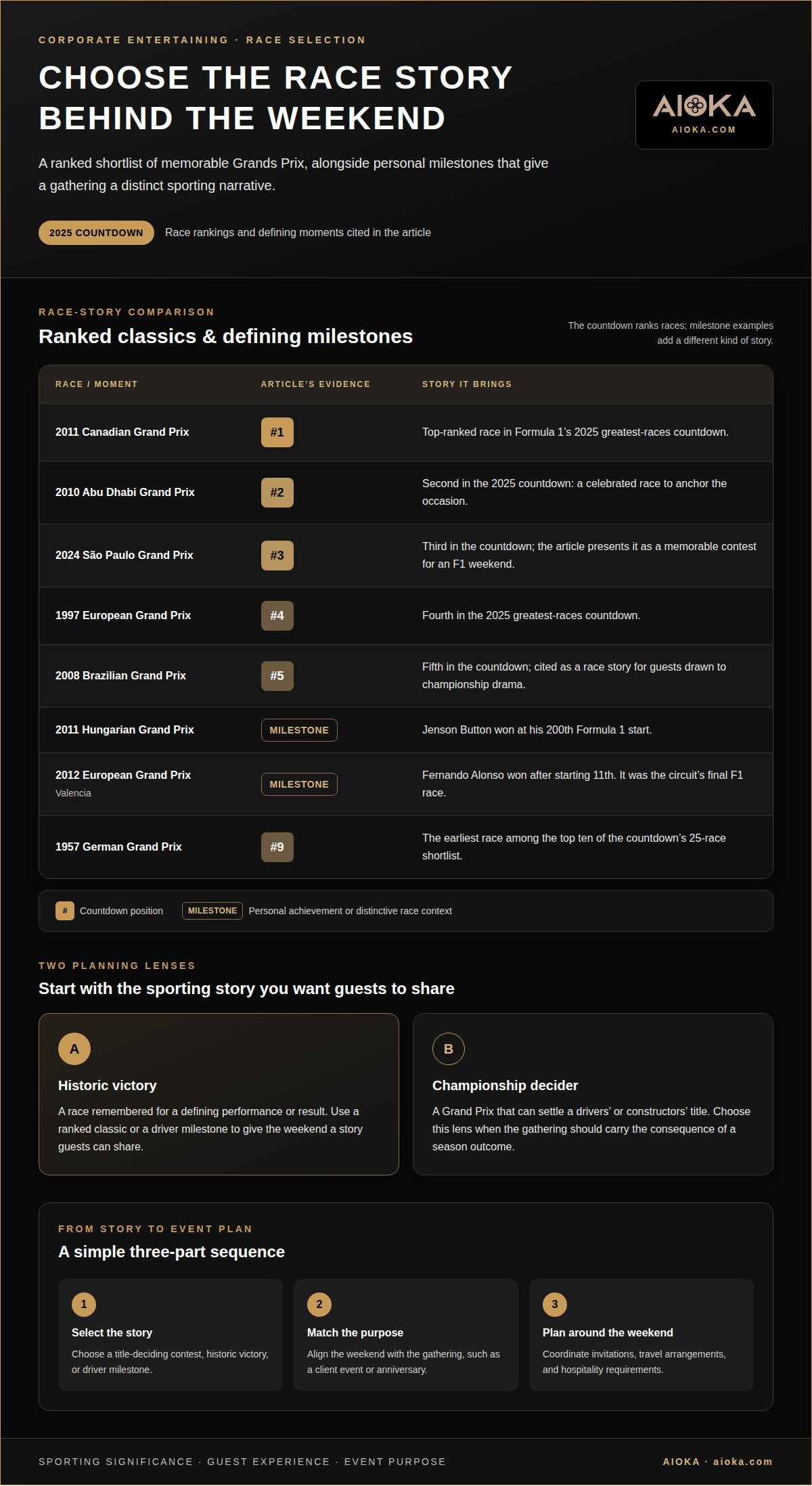
For a race built around drama, consider Formula 1’s 2025 greatest-races countdown. It ranked the 2011 Canadian Grand Prix first, the 2010 Abu Dhabi Grand Prix second, and the 2024 São Paulo Grand Prix third. The same countdown placed the 1997 European Grand Prix fourth and the 2008 Brazilian Grand Prix fifth. These examples help distinguish a celebrated race from a weekend selected chiefly for its championship stakes.
For a personal achievement, the 2011 Hungarian Grand Prix offers a clear narrative: Jenson Button won at his 200th Formula 1 start. The 2012 European Grand Prix in Valencia gives guests another memorable arc, with Fernando Alonso winning after starting 11th. It was the circuit’s final F1 race. For earlier history, the 1957 German Grand Prix ranked ninth in the 2025 countdown, making it the earliest race on that 25-race shortlist’s top ten.
Use a simple sequence when setting the booking window:
Select the story.
Choose a title-deciding contest, historic victory, or driver milestone, such as Button’s 2011 win.
Match the weekend to the purpose.
A championship narrative suits a client gathering focused on the season’s outcome; an anniversary can centre on a landmark race.
Plan around the chosen event.
Coordinate guest invitations, travel arrangements, and hospitality requirements with the selected Grand Prix weekend.
Begin planning once you have chosen the race and defined its role in the event. This helps coordinate the sporting story, guest experience and practical arrangements from the outset.
F1 Travel, Lodging, and Transport Challenges for Companies
A travel plan coordinates guests’ arrivals, accommodation and journeys around a Grand Prix weekend. Start with the circuit and event schedule, then map each guest’s route from arrival point to hotel and venue. At Silverstone, for example, the circuit is outside central London, so accommodation and onward transport shape the day. Build the itinerary around the actual event programme rather than assuming guests can move freely between commitments.
A lodging cluster is a group of accommodation options selected to keep guests together or close to shared transport. Choose it according to the circuit’s location, the event schedule and guests’ arrival arrangements. For a race at Circuit Gilles Villeneuve, consider how hotel location affects the group’s journey to the venue and back. Share accommodation details early, especially when guests are arriving from different cities or countries.
A transfer plan sets out how guests will travel between key points during the event. Specify collection locations, departure times, guest groups and how you will communicate itinerary changes. At Yas Marina, for instance, map the journey between accommodation and the circuit before setting hospitality timings. Avoid relying on a single transfer arrangement; allow flexibility for staggered arrivals and different guest commitments.
Use this sequence to structure planning:
Group arrival details.
Record each guest’s arrival point and timing, then identify shared journeys and individual requirements.
Match accommodation to the programme.
Choose a lodging area that supports the circuit itinerary and planned guest gatherings.
Set transfer arrangements.
Establish pickup points, departure windows, and a clear update channel for the group.
Keep the itinerary legible.
Share one schedule showing travel, accommodation, and race-weekend commitments.
These arrangements make logistics part of the hospitality design, rather than a separate afterthought. To shape a cohesive event around a chosen Grand Prix, explore F1 weekend planning.
How do F1 races compare with other sporting events for corporate entertaining?
Corporate entertaining uses a live sporting occasion to host clients, colleagues, or partners. Formula 1 differs from football, tennis, and golf through its combination of racing, engineering, and a circuit-wide event atmosphere. The right choice depends on whether the gathering calls for sustained conversation, a shared spectacle, or a specific sporting story.
Formula 1 hospitality places the race at the centre of a wider weekend experience. The 2024 São Paulo Grand Prix, ranked third in Formula 1’s 2025 greatest-races countdown, can anchor an event around a memorable contest. Compared with a football match, where attention centres on one fixture, an F1 weekend offers more room to build an occasion around practice, qualifying, and race day. That broader rhythm can suit groups who value time together as well as the main event.
Football hospitality centres on a match between two teams, making the fixture itself the principal shared narrative. It can be a natural fit when guests already follow a club or rivalry. By contrast, the 2008 Brazilian Grand Prix, ranked fifth in the 2025 countdown, offers a distinct race story for guests drawn to championship drama. Tennis, such as Wimbledon, can suit a more dispersed day, with attention moving between matches and courts.
Golf hospitality is an event format built around a tournament played across a course. It can offer a slower pace than an F1 race, while Formula 1 brings concentrated competition and a strong focus on machinery and teams. Neither format is universally preferable; the decision should reflect the guests’ interests and the business purpose.
Use these criteria to compare options:
Guest affinity
choose football for a known team connection, or F1 for interest in racing and engineering.
Conversation rhythm
consider golf for a more gradual day and F1 for a weekend structured around race activity.
Event narrative
select a Grand Prix with a historic victory or championship context when the story should shape the gathering.
The best F1 races for corporate entertaining are those whose sporting character supports the intended guest experience, rather than simply carrying the most familiar name.
Grand prix
A Grand Prix is a Formula 1 race held as part of the World Championship. For corporate entertaining, a race’s value can come from its historic result, its place in the season, or its standing among fans. The 2012 Brazilian Grand Prix offers a distinctive reference point: Formula 1 ranked it eighth in its 2025 greatest-races countdown.
RaceFans readers also rated the 2012 Brazilian Grand Prix at Interlagos 9.45 out of 10, placing it first in their list at the end of the 2025 season. That reader rating and Formula 1’s countdown use different measures, so treat them as complementary signals, not a single verdict. One reflects readers’ assessments; the other gives a historical ranking.
The 2019 German Grand Prix at Hockenheimring received 9.44 out of 10 from RaceFans readers, placing second in their list. The 2011 Chinese Grand Prix at Shanghai International Circuit followed with 9.24 out of 10, ranking third. These examples offer a useful way to build a shortlist around races with strong recorded appreciation, rather than choosing by destination alone.
Other highly rated choices broaden the selection. RaceFans readers rated the 2014 Canadian Grand Prix at Circuit Gilles Villeneuve 9.19 out of 10, placing fourth. The 2014 Hungarian Grand Prix at Hungaroring received 9.14 out of 10, while the 2015 United States Grand Prix at Circuit of the Americas scored 9.1 out of 10. Both offer distinct settings for a hosted event.
Use three filters to move from shortlist to selection:
Story
decide whether history, a season-defining result, or fan recognition should lead.
Guest fit
match the race and destination to guests’ interests and travel plans.
Evidence
compare Formula 1 rankings with RaceFans reader ratings, noting what each measure represents.
The best F1 races for corporate entertaining pair a compelling sporting context with a guest experience suited to the occasion. Plan your Grand Prix event around the race story and the purpose of your gathering.
AIOKA: Corporate Hospitality Packages
AIOKA brings the race selection into focus through Corporate Hospitality Packages designed for Formula 1 weekends. Once you have chosen a Grand Prix for its sporting history, championship context, or guest appeal, the next step is shaping the occasion around your business purpose and the people attending.
Corporate Hospitality Packages provide a setting for hosting clients and partners, while Brand Activation Services give a company’s presence a considered role at the event. Curated Culinary Experiences add another dimension, creating an occasion that extends beyond the race itself. Together, these offerings can reflect the selected Grand Prix and the relationships you want to cultivate.
Contact AIOKA to discuss a corporate hospitality experience for your chosen F1 weekend.
Shape the Next Grand Prix Gathering
The most considered F1 occasion begins with a clear intention: decide what guests should take away, whether a deeper relationship, a shared point of reference, or a fresh view of your brand. Choosing the best F1 races for corporate entertaining is less about selecting the most celebrated name and more about matching the event’s sporting character to that intention.
Carry that purpose through the invitation, the conversations you hope to encourage and the atmosphere you want guests to remember. A well-planned event gives each element a role: the race provides the setting while the business objective remains present. This clarity makes the next planning decision more deliberate and coherent.
Begin shaping the experience around your priorities and chosen Grand Prix. Contact AIOKA about corporate entertaining to take the next step toward an occasion designed with intention.
Frequently Asked Questions
How do F1 race weekends compare for client entertainment, networking, and atmosphere?
Each weekend’s suitability depends on the balance you want between shared spectacle and conversation. For a client meeting, consider whether guests can gather comfortably around the event rather than making the race the only focus. If you are entertaining a mixed group, shape invitations around different interests and pair racing with time for introductions and private discussion. The best fit reflects the intended tone and relationships.
How much do F1 corporate hospitality packages cost at each Grand Prix?
Pricing depends on the Grand Prix and the scope of the bespoke package, and is provided after a quote request. Key cost factors include the event location, package duration, hospitality requirements and selected elements. A multi-day programme at one race may differ from a tailored arrangement at another, so define your priorities before requesting a quote.
What is included in F1 Paddock Club and other hospitality packages?
In AIOKA’s Corporate Hospitality Packages, confirmed elements include trackside viewing suites, curated gourmet dining, and private client entertaining facilities. The precise arrangement can be shaped around the event’s purpose and chosen Grand Prix. For example, a host planning a partner gathering can consider how dining and private entertaining support the day’s programme. Package contents should not be assumed identical across different providers or event formats.
Which F1 races offer the best access to executives, drivers, and team experiences?
Do not choose a Grand Prix on the assumption that it guarantees access to drivers or teams. For executive hosting, focus first on the hospitality setting and bringing invited guests together. If your group wants a more visible brand presence, consider AIOKA’s Brand Activation Services; for a gathering centred on conversation, make private entertaining and dining priorities in the programme.


