
F1 Hospitality Logistics for Corporate Race Weekend Planners
How to build one itinerary for race weekend guests, covering circuit access, transfers, sponsor meetings, dining and hospitality venue requirements.

A race weekend runs more smoothly when every appointment is built into one coordinated itinerary before guests arrive. A useful F1 hospitality logistics checklist for corporate planners maps circuit access, transfer arrangements, sponsor events, meetings, dining, hospitality inclusions and venue requirements in a single schedule. The essential distinction is between access within the hospitality venue and the separate arrangements needed to reach it, move between commitments and depart after the event.
When clients, sponsors and senior colleagues share a packed schedule, even a well-appointed hospitality setting cannot solve overlapping appointments or unclear arrival plans. The practical task is to align each commitment with the right access details, timings and guest movements, while preserving time for conversation and relationship-building.
This guide explains how to organise circuit access and pickup coordination, sequence sponsor events and business meetings, clarify food and beverage inclusions, and assess venue arrangements that shape the guest experience. It also shows how tailored corporate hospitality, brand activations and curated culinary experiences can bring these elements together.
Key Takeaways
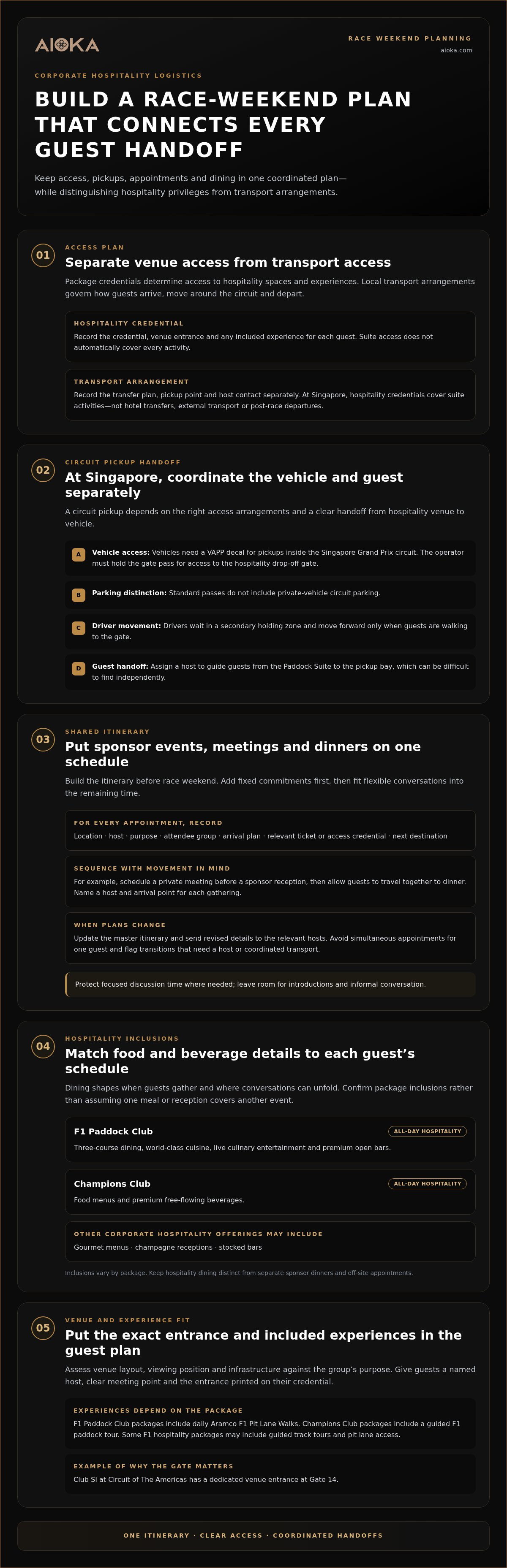
• Separate hospitality access from transport and circuit pickup arrangements; at the Singapore Grand Prix, circuit pickups require a VAPP decal, with drivers called forward from a secondary holding zone.
• Build sponsor events, client meetings and dinners into one itinerary before race weekend, allowing time for guest movements between commitments.
• Review food and beverage inclusions alongside the format of each hospitality experience, so the day’s dining and hosting arrangements support your guests’ needs.
• Assess venue layout, viewing position and infrastructure against your group’s purpose; AIOKA’s corporate hospitality, brand activation and culinary offerings can bring those elements into a considered guest experience.
Circuit access decals and pickup zones
F1 hospitality options and local logistics differ by Grand Prix venue: package credentials determine access to hospitality spaces and experiences, while local transport arrangements govern circuit arrival and departure. At Singapore, for example, hospitality credentials cover suite activities, not hotel transfers, external transport or post-race departures.
Start with a guest-by-guest access plan. Record each person’s credential, venue entrance, meeting point, transfer arrangement and host contact in the itinerary. For pickups inside the Singapore Grand Prix circuit, vehicles need a VAPP decal. The operator must hold the gate pass for access to the hospitality drop-off gate, and standard passes do not include private-vehicle circuit parking.
Coordinate vehicle movements separately from guest movements. For pickups inside the Singapore circuit, drivers wait in a secondary holding zone and move forward only when guests are walking to the gate. Assign a host to guide guests from the Paddock Suite to the pickup bay, which can be difficult to find independently. This handoff connects the hospitality venue to the correct vehicle and departure point.
Hospitality access can also include experiences beyond the suite. F1 Paddock Club packages include daily Aramco F1 Pit Lane Walks, while Champions Club packages include a guided tour of the F1 paddock. Some F1 hospitality packages may include guided track tours and pit lane access. Match each experience to the guest’s credential and itinerary; don’t assume suite access alone covers every activity.
At the circuit, direct guests to the entrance printed on their credential and keep the group together when moving between scheduled activities. Venue access can be made more orderly by naming one host, setting a clear meeting point and sharing the relevant access details before arrival. For example, Club SI at Circuit of The Americas has a dedicated venue entrance at Gate 14, illustrating why the precise gate belongs in the guest plan.
Build these details into the F1 hospitality logistics checklist for corporate planners: credential scope, entrance, decal and gate-pass arrangements, pickup location, driver holding instructions, host handoff and any included paddock or pit lane experience. This keeps access and movement aligned without confusing hospitality privileges with transport permissions.
Coordinating sponsor events, meetings, and dinners
Prepare the guest itinerary before race weekend, combining sponsor travel, hospitality events, business meetings and dinner reservations in one schedule. A master document should list each appointment’s location, host, purpose and arrival plan. Include the relevant ticket or access credential for every circuit commitment. This gives planners a complete view of the event schedule and makes clashes easier to spot. Add fixed commitments first, then fit flexible conversations into the remaining time.
Sequence appointments by location and guest group. For example, schedule a private meeting before a sponsor reception, then allow guests to travel together to dinner. Name a host and specify an arrival point for every gathering. Keep essential business discussions distinct from social occasions, while allowing time for introductions and informal conversation. If an appointment changes, update the shared itinerary and notify the people welcoming guests. This prevents an invitation from turning into a confusing arrival or missed meeting.
Before the weekend
Collect meeting, sponsor, dining, and travel commitments in one itinerary.
For each appointment
Record the location, host, attendee group, access detail, and next destination.
For schedule changes
Update the master version and send the revised details to relevant hosts.
Use the same planning structure for every guest group, but tailor each itinerary to its purpose. A prospective partner may need protected time for a focused discussion; an established client may prefer a relaxed dinner after circuit activities. Avoid scheduling simultaneous appointments for one guest, and flag transitions that need a host or coordinated transport. These details help planners make the weekend about relationship-building, not simply a sequence of invitations.
A considered F1 hospitality logistics checklist for corporate planners connects every meeting to its host, setting, and onward movement. For a more composed guest experience, explore refined race weekend planning as part of your event preparation.
Food and beverage inclusions
Food and beverage arrangements shape the rhythm of a Grand Prix weekend. F1 Paddock Club is described as an all-day hospitality offer with three-course dining, world-class cuisine, live culinary entertainment, and premium open bars. Treat those inclusions as part of the guest experience, not simply a meal between track sessions. They influence when guests gather, how long they remain, and where business conversations can unfold comfortably.
Champions Club packages include all-day hospitality, food menus, and premium free-flowing beverages. Other F1 corporate hospitality offerings may include gourmet menus, champagne receptions, and stocked bars. Inclusions vary by package, so use the guest itinerary to distinguish what belongs to the hospitality setting from separate sponsor dinners or off-site appointments. This prevents a reception or meal from being assumed to cover another event.
Before the weekend, map hospitality and dining arrangements against meetings and circuit activities. For example, if a sponsor reception comes before dinner, give guests a clear transition between the two. Share relevant food and beverage details, the attendee list and timings with the event host. This helps the host set the right tone, whether the occasion calls for a polished reception or a relaxed meal.
Review the package
Record the stated dining format, bar provisions, and culinary entertainment.
Shape the schedule
Place meals and receptions around meetings and circuit commitments.
Brief the host
Share the guest group, occasion, timing, and planned transitions.
For a luxury corporate setting, comfort also depends on how well the food service fits the event’s purpose. A hosted lunch can preserve time for conversation, while an evening dinner can offer a more deliberate setting for relationship-building. Use the F1 hospitality logistics checklist for corporate planners to distinguish package inclusions from separately arranged meals, then align each gathering with its guests and objectives. This makes culinary detail an intentional part of the weekend’s hospitality design.
Hospitality venue capacity and infrastructure
Book once your dates, guest numbers and venue requirements are defined, as demand and available space shape the practical timing. Before committing, review the written cancellation and postponement terms, including deadlines, inclusions and conditions that may affect changes.
Hospitality Capacity
Capacity determines whether a venue suits the intended guest group and gathering style. Compare the overall guest count with the space available for dining, conversation, and viewing the action. At Abu Dhabi, Paddock Club guest volumes can reach about 5,500 people per day, illustrating the scale of a major race weekend. A private suite and a shared lounge also create different settings, even when both offer trackside views.
For a useful comparison, assess the guest experience rather than capacity alone. Consider whether attendees can gather comfortably, hold business conversations, and enjoy the race together. The F1 hospitality logistics checklist for corporate planners should record group size, venue format, and the purpose of each gathering before selecting a space.
Venue Infrastructure
Infrastructure includes the layout, viewing position, dining areas, and spaces for hosting guests. At Circuit of The Americas, The Terrace at Turn 6 overlooks the esses in Turns 4-6, while Club SI overlooks Turns 12-15. Those distinct sightlines shape how guests experience the action, so match the venue’s position to the event’s priorities.
Miami’s Paddock Club expansion is planned to add 115,000 square feet, bringing total hospitality space to about 305,000 square feet and capacity to roughly 9,200 guests. Treat these planned figures as a venue-development example, not a general measure for every circuit. Review how each space supports guest circulation, dining, and the intended event format.
Cancellation exposure depends on the written booking terms. Review the applicable cancellation, postponement, and change provisions before committing, and note how they address guest-count adjustments and package inclusions. To shape a considered trackside setting for your event, plan tailored hospitality arrangements.
AIOKA: Corporate Hospitality Packages
AIOKA brings corporate race-weekend plans together through Corporate Hospitality Packages built around premium trackside experiences. Its Brand Activation Services help brands create a considered presence, while Curated Culinary Experiences add distinctive food and hosting. These services are a natural next step when your venue, guest objectives and event schedule need to work as one coherent experience.
Turn to AIOKA when you are planning to host clients at a Formula 1 Grand Prix, create a brand activation, or elevate the culinary dimension of your hospitality. Share the event’s purpose and the experience you want guests to remember, then explore how the appropriate offering can support that direction.
To discuss your corporate race-weekend plans, contact AIOKA or visit aioka.com.
Shape the Guest Experience with Intention
Start the planning conversation by defining what a successful weekend should achieve: deeper dialogue with existing clients, a considered introduction to prospective partners, or a more distinctive expression of your brand. This gives stakeholders a shared point of reference and helps the guest experience feel coherent rather than assembled from separate decisions.
Use an F1 hospitality logistics checklist for corporate planners as a working brief, connecting the experience you want to create with the commercial purpose behind the invitation. AIOKA can help shape that vision into a considered hospitality experience, bringing clarity to the planning process while keeping the occasion centred on your guests and business relationships.
When you are ready to develop your plans, contact AIOKA to plan your hospitality. A clear intention is a graceful beginning to a race weekend designed with purpose.
Frequently Asked Questions
How can I manage multiple race weekend appointments?
Use one shared schedule as the master version, and assign someone to maintain it. Give every appointment a priority, attendee list, host and contingency contact. If a sponsor meeting runs late, the schedule owner can identify which later commitment needs adjusting and inform affected guests. Keep personal calendar entries aligned with the master schedule so executive assistants and event hosts work from the same plan.
What is the best transport option for F1 hospitality guests?
For guests with several commitments, a pre-arranged chauffeur itinerary can make point-to-point travel more coherent than separate, uncoordinated journeys. Match the arrangement to each guest’s arrival point, circuit destination and evening plans. At Singapore, hospitality credentials do not cover hotel-to-circuit transfers or travel between evening venues, so guests or their appointed chauffeur operator need to arrange those journeys separately.
What vehicles work best for hospitality transport?
Choose a vehicle to suit passenger numbers and luggage. A luxury sedan or executive saloon works for an individual guest or small group, while an executive MPV or minibus offers more seating and luggage space. A guest travelling with presentation materials, for example, may need more room than someone arriving alone. Match vehicle allocation to each itinerary instead of assuming every guest has the same transport needs.
What is included in F1 hospitality packages for corporate groups?
Inclusions depend on the package. Corporate hospitality can bring together trackside viewing, dining, and private client entertaining, while some packages include experiences such as pit lane walks, paddock tours, or guided track tours. For instance, F1 Paddock Club is described as all-day hospitality with three-course dining. Read the package details as a complete guest experience, distinguishing included activities from separately arranged events.
How do corporate guests travel to the circuit, and what transport should planners arrange?
Plan circuit travel as a separate part of the guest itinerary, especially when hospitality credentials cover the suite but not external transport. A planner can coordinate hotel departures, circuit arrivals and onward journeys through an appointed chauffeur operator. For Singapore, that operator handles hotel-to-circuit transfers and post-race departures. Include each guest’s destination after the event, as evening plans may require additional transport.
What are the parking, shuttle, and arrival procedures at major F1 circuits?
Arrival procedures vary by circuit, so build the plan around the event’s designated access and pickup arrangements. At the Singapore Grand Prix, private-vehicle circuit parking is limited and is not included with standard passes; vehicles making pickups or drop-offs inside the circuit need a VAPP decal. Do not mistake a hospitality credential for a parking or vehicle-access pass, and distinguish shuttle arrangements from private-vehicle access.


