F1 Corporate Event Production: From Strategic Brief to Race Weekend
F1 Corporate Event Production: From Strategic Brief to Race Weekend
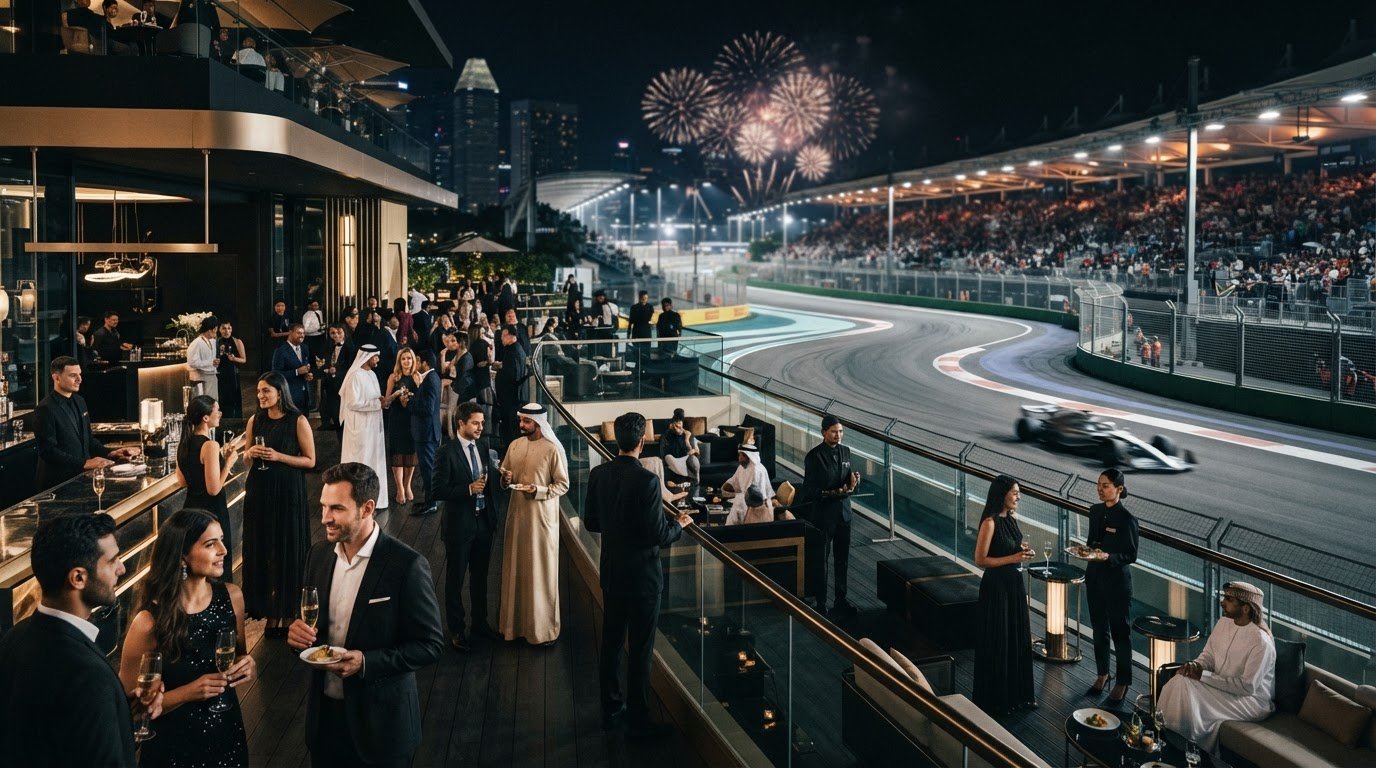
The spectacle of a Formula 1 weekend is immediate; its business value is deliberately designed. Effective f1 corporate event production starts before guests reach the circuit. It connects the company’s objective to the setting, guest experience and conversations the event is intended to encourage.
Hospitality, event production and brand activation are related, but they do different jobs. Hospitality shapes how guests are welcomed and entertained. Activation gives a brand a purposeful way to engage them. Production coordinates the people, schedule and details that bring those elements together. Without that coordination, even an exceptional setting can feel disconnected from the reason for bringing people together.
This article explains how an F1 corporate event moves from strategic brief to race weekend, and how to shape its workstreams around distinct business aims. You’ll learn how to translate objectives into a practical guest journey, coordinate hospitality, curated dining and activation, and evaluate the event after guests depart. From the invitation to the closing conversation, considered production helps the energy of race weekend serve a clear commercial purpose.
Key Takeaways
• Successful f1 corporate event production connects business objectives, guest experience and live delivery in one considered plan.
• Use a five-stage production lifecycle to clarify decisions, responsibilities and handovers from the initial brief through evaluation.
• Choose a hospitality-led, networking or activation-focused format according to the outcome the event is designed to support.
• Shape each guest touchpoint, transition and hosted moment around a coherent race-weekend journey and run of show.
• Assess immediate engagement separately from longer-term relationship and commercial outcomes to understand the event’s contribution.
F1 Corporate Event Production: What the Work Actually Encompasses
F1 corporate event production is the coordinated planning and delivery of a corporate programme at a Formula 1 race weekend. It aligns business objectives, guests, spaces, schedules, content, operations and evaluation. It is broader than hospitality access, which provides a setting for hosting, and broader than a standalone brand activation, which creates a specific way for an audience to engage. Production brings these elements into a single plan.
A Grand Prix weekend is a live-event environment shaped by race activity. Guest movement, hosted conversations, dining and brand moments need to fit around the event schedule, rather than run as though they were a separate gathering. The Formula One Paddock Club, for example, is associated with corporate hospitality and VIP service. Access to a hospitality setting alone, however, does not determine how a company’s event will meet its objectives.
How production differs from hospitality and brand activation
Production coordinates the people, spaces, schedule, content and suppliers needed to make an event work as a whole. Hospitality is a way of hosting; activation is a way of engaging guests with a brand, product or message. They can complement each other, but neither replaces the overall production plan.
Consider a company aiming to deepen relationships with a small group of strategic clients. Its programme might centre on a hosted meal, with time set aside for personal conversation and a discreet brand moment that gives guests a shared point of interest. If the aim is broader partner engagement, the programme might instead invite participation through a distinctive activation. In either case, the objective should shape the format and the practical decisions behind it.
Which corporate objectives can an F1 event serve?
A race-weekend programme can support client relationships, partner engagement, executive networking or recognition of valued stakeholders. Each objective calls for a different kind of interaction. Focused conversation benefits from a measured setting and enough time to talk; broader participation needs moments that make it easy for a larger group to get involved.
Clarify the intent before choosing the setting, programme or creative direction. A useful brief names the audience, the response the company hopes to encourage and the indicators it will use to assess progress. Those indicators could include participation, the quality of conversations or agreed follow-up. Longer-term business outcomes may take more time to assess. With this foundation, f1 corporate event production can align the setting, content and operations with a defined commercial purpose instead of letting the scale of the race weekend dictate the experience.
From Corporate Brief to Race Weekend: The F1 Production Lifecycle
A coherent race-weekend programme develops through connected stages. Each stage turns the original business intent into decisions the next workstream can use. The event brief anchors production decisions and helps keep the purpose clear as creative choices, operational plans and live conditions evolve.
Turning business priorities into a production brief
Before selecting a space or activity, define who the event is for, which relationships it should support, how guests should experience the programme and what evidence will indicate progress. Record decision owners, constraints, essential event information and approval responsibilities in one working brief. This gives the client team, production leads and suppliers a shared reference point, so decisions remain connected to the intended outcome.
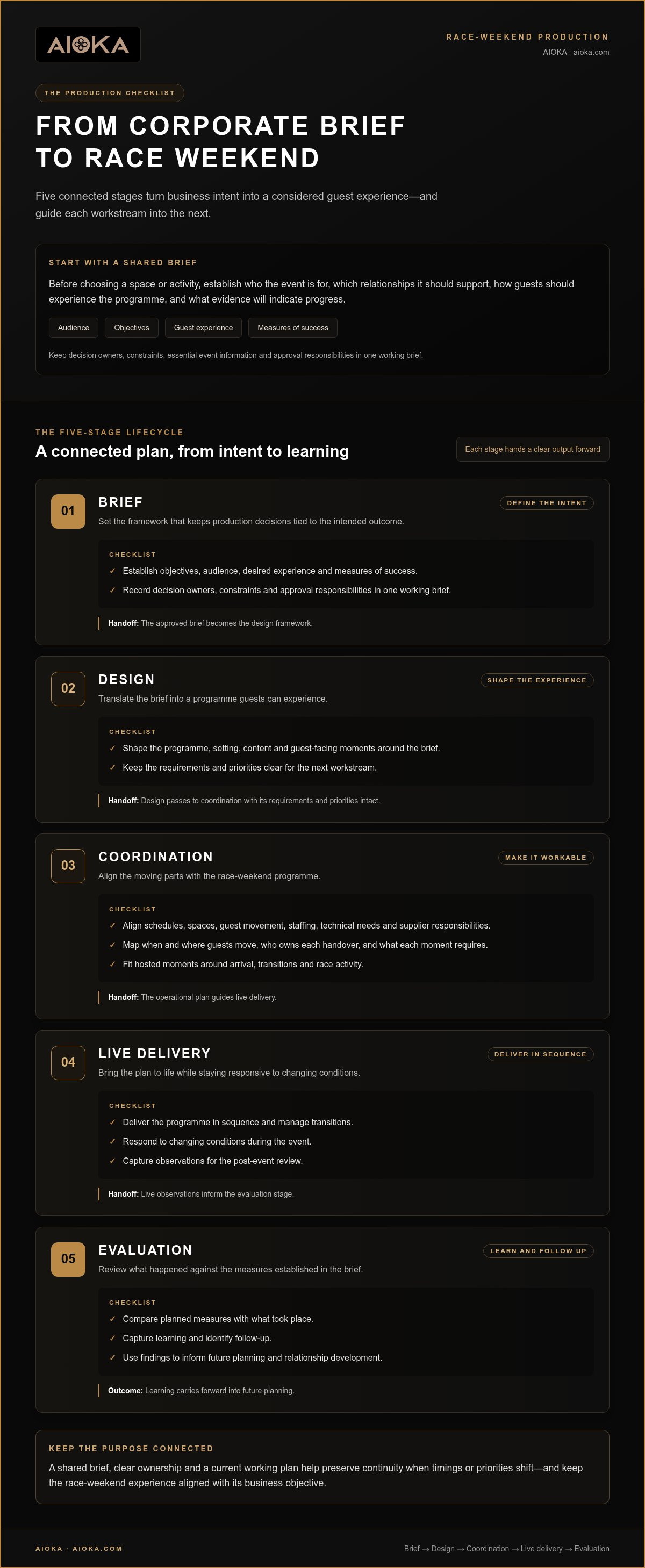
The lifecycle can be understood as five stages, each with a clear purpose, key decisions and handover:
Brief
Establish objectives, audience, desired experience and measures of success. The approved brief becomes the design framework.
Design
Shape the programme, setting, content and guest-facing moments around the brief. Hand the design to coordination with its requirements and priorities intact.
Coordination
Align schedules, spaces, guest movement, staffing, technical needs and supplier responsibilities. The operational plan guides live delivery.
Live delivery
Deliver the programme in sequence, manage transitions and respond to changing conditions. Capture observations for the post-event review.
Evaluation
Compare planned measures with what took place, capture learning and identify follow-up. Use the findings to inform future planning and relationship development.
Coordinating design, operations and live delivery
Design establishes the intended atmosphere and sequence; coordination makes that vision workable within the race-weekend programme. Production leads connect the two by mapping when and where guests move, who owns each handover, and what staffing or technical arrangements each moment requires. To understand how audio-visual requirements integrate into wider staging and event flow, learn more about Debut Media AV and Production. For example, a hosted meal needs to fit within a wider schedule that accounts for arrival, transitions and race activity.
For a multi-day programme, clear decision-making is as important as a detailed schedule. Named owners, agreed approval routes and a current working plan help maintain continuity when timings or priorities shift. They also help each day feel considered rather than assembled in isolation. Established event production best practices offer useful wider context, while the specific plan should reflect the event’s objectives and setting.
Build evaluation into the plan from the outset. Decide which measures matter and who will gather feedback before guests arrive. For a considered view of how hospitality and activation can come together at Formula 1 weekends, explore AIOKA’s F1 corporate experiences.
Choosing an F1 Corporate Event Format That Fits the Objective
The right format is not necessarily the most elaborate; it is the one that gives the intended guests the right way to engage. In f1 corporate event production, hospitality, networking and activation can each lead the experience, provided the format suits the business objective and its operational demands.
| Format | Primary objective | Guest interaction | Production emphasis | Suitable programme shape |
|---|---|---|---|---|
| Hospitality-led hosting | Develop client relationships or recognise valued guests | Hosted conversation, dining and shared race-weekend viewing | Setting, hosting, service and space for conversation | A considered sequence of arrival, hosted moments and relaxed time together |
| Executive networking | Connect senior guests, clients or partners | Structured introductions and purposeful informal exchange | Guest composition, access, facilitation and well-paced transitions | A reception or gathering with clear opportunities to meet and continue conversations |
| Brand activation | Encourage participation and express a brand message | Guests interact with an experience, content or branded environment | Concept, visibility, participation flow and the message guests encounter | A defined engagement moment within a wider hospitality or event programme |
Hospitality-led hosting for relationship development
Trackside settings and curated dining create a distinctive environment for client engagement. Shape the style of hosting around how guests are expected to spend time together. A small group seeking focused conversation may suit a more private or semi-private setting; a larger programme may benefit from shared hosted moments balanced with room to move and connect. Hospitality can support relationship-building, but the setting alone cannot guarantee a business outcome.
Networking and activation-led programme design
Networking formats depend on the guest mix, how introductions are facilitated and the balance between shared experiences and open conversation. Activation-led programmes centre on participation and brand expression, with a defined purpose for the interaction rather than visibility alone. The most prominent installation is not automatically the most effective. If it attracts attention without advancing the event’s intent, its scale may add complexity without adding value.
Production choices also depend on the guest’s role. Observers need a clear vantage point and well-timed hosted context. Participants need an intuitive activity and a smooth flow through it. Active networkers need space, introductions and time to converse. Formats can be combined, such as pairing hosted dining with a concise activation, when each element has a distinct purpose and the schedule, staffing and guest movement remain coherent. AIOKA’s corporate hospitality experiences bring hosting, curated culinary moments and brand activations into a wider race-weekend programme.
Managing the F1 Race-Weekend Guest Journey and Live Production
A well-produced race-weekend event feels composed to guests because the detail behind it has been carefully aligned. The journey starts before arrival, with an invitation that sets expectations and clear information to help guests prepare. Arrival, welcome, hosted moments, transitions between settings and departure should each feel like part of one considered experience.
A run of show is the shared operational plan that aligns guest-facing moments, timings, responsibilities and communications for live event delivery. It connects the programme to the wider race-weekend schedule, giving hosts, production teams and event partners a common reference. In f1 corporate event production, the plan should identify who leads each moment, who communicates changes and how teams stay coordinated across the programme.
Designing a coherent schedule around race-weekend activity
Build the schedule around fixed programme moments, then arrange flexible periods for dining, networking and hosting around them. The aim is not to fill every interval, but to create purposeful pacing and enough time for guests to move, settle and engage. Before setting operational details, verify the circuit-specific schedule and relevant access requirements, since arrangements can vary by event and location.
Useful planning distinctions include:
Fixed moments
Scheduled race activity and other confirmed programme commitments that shape the event’s timing.
Flexible periods
Hosting, dining and networking moments that can be arranged around those commitments.
Transitions
The time and communication needed for guests and teams to move from one part of the experience to the next.
Preparing teams for change and contingency
Allow for relevant disruptions, such as schedule changes, weather, transport delays, technical interruptions or a guest requiring additional assistance. These are planning categories, not a universal circuit procedure; the response should reflect the specific setting and event arrangements. A proportionate plan assigns decision ownership, defines how updates reach hosts and production teams, and clarifies when event partners need to be informed.
Role clarity matters most when the programme changes. Hosts can stay focused on guests when they know whom to consult. Production teams can adjust timing when decision routes are clear. Partners can respond consistently when they receive the same information. Contingencies should be discreet, preserving the intended guest experience wherever practical rather than making operational adjustments the centre of attention.
For a race-weekend programme shaped around considered hosting, guest flow and live coordination, explore AIOKA’s corporate hospitality experiences.
Evaluating the Event and Shaping a Bespoke AIOKA Experience
A useful evaluation returns to the purpose set at the outset. Attendance or immediate enthusiasm alone does not establish commercial impact. Assess what the event made possible, what guests engaged with and what should inform the next programme. In f1 corporate event production, evaluation is most useful when measures are selected before the event and tied directly to its intended outcome.
Measuring outcomes without reducing the experience to a single metric
Choose a small set of indicators that reflect the event’s objective. For relationship development, consider whether priority guests attended, what hosts observed about the quality of conversations and whether agreed follow-up took place. For an activation, participation and guest feedback can help show whether the experience prompted meaningful engagement. These indicators provide context, not guarantees of a commercial result.
Separate immediate responses from outcomes that take longer to emerge. Guest comments, participation and host observations can be reviewed soon after the race weekend. Relationship progression, qualified opportunities or business results may require later assessment through the company’s own follow-up processes. A measured evaluation can include:
Guest response
Attendance, participation and relevant feedback on the experience.
Relationship signals
Conversations initiated, follow-up agreed and the development of key connections over time.
Delivery insight
Stakeholder observations on programme flow, guest experience and areas to refine.
Feedback from guests, hosts and event stakeholders gives the review a fuller perspective than a single post-event impression. Compare those observations with the original intent, identify which elements supported it and record adjustments for future race-weekend programmes. This keeps learning practical without reducing a complex experience to one measure.
How AIOKA brings hospitality and activation into one programme
AIOKA brings premium corporate hospitality and curated brand activation together within Formula 1 race-weekend experiences. Its work includes exclusive trackside locations, curated gourmet dining and private client entertaining, with the programme shaped around the company’s purpose and the guests it wants to engage. A brand moment can complement a hosted experience when it has a clear role. When focused conversation is central to the brief, private executive networking can be given appropriate space.
This bespoke approach aligns the setting, guest experience and brand expression, so each element contributes to a coherent programme rather than competing for attention. For organisations considering a race-weekend event, AIOKA’s F1 event production brings hospitality and activation together around a defined corporate objective.
Shape a Race Weekend Around Your Business Purpose
Effective f1 corporate event production begins with a clear objective and carries it through every decision, from the format and guest journey to live coordination and post-event evaluation. When hospitality, networking and brand activation each serve a defined role, the scale of a Grand Prix weekend can support meaningful business relationships without losing coherence.
This discipline also makes success easier to assess. Immediate guest engagement offers useful signals, while relationship progression and commercial outcomes may take longer to understand. A considered review turns both into insight for future programmes.
AIOKA brings more than 15 years of experience in premium Formula 1 hospitality and brand activations, with access to races worldwide and curated trackside corporate experiences. Its approach brings hospitality and activation together around the intended guest experience and business purpose. Explore AIOKA’s approach to Formula 1 corporate event production and start shaping a race-weekend programme around your business objective.
Frequently Asked Questions
What does F1 corporate event production include?
F1 corporate event production includes the planning and coordination needed to bring a business objective to life during a Grand Prix weekend. It connects the brief, audience, event format, setting, content, guest journey, schedule, teams and suppliers, then considers how outcomes will be evaluated. The scope may include hospitality, curated dining, executive networking or brand activation, integrated into a programme that works around race-weekend activity.
How is F1 corporate event production different from corporate hospitality?
Corporate hospitality is a hosting format; production is the wider framework that shapes and coordinates the event. Hospitality may provide a setting for guests to dine, watch race activity and connect, while production aligns that experience with the company’s objective, programme, guest movement, staffing and live delivery. A hospitality package can be one component of an event, but production determines how it fits into the overall experience and business purpose.
How far in advance should a company plan an F1 corporate event?
Begin planning as early as practical, particularly if the programme involves a defined guest list, trackside setting, dining, brand activation or multiple event moments. The appropriate lead time depends on the race, format, operational requirements and decisions the company needs to make. Starting with the objective and audience allows the production plan to take shape before detailed choices are made, while leaving time to coordinate the schedule, responsibilities and guest communications.
What types of corporate events can be produced during an F1 race weekend?
Common formats include hospitality-led client entertaining, executive networking, partner engagement, stakeholder recognition and brand activations. A programme might centre on hosted dining and conversation, bring senior guests together through a structured networking experience, or invite participation in a branded activity. The format should reflect the intended outcome and audience. These approaches can also be combined, provided each element has a clear purpose and the overall programme remains coherent.
How do you coordinate a corporate event around a Formula 1 race schedule?
Build the event schedule around confirmed race-weekend activity, separating fixed commitments from flexible hosting, dining and networking periods. A run of show should align guest-facing moments with timings, transitions, team responsibilities and communication routes. Verify the circuit-specific schedule and access requirements before setting operational details, as these vary by event. Allow purposeful time for guests to move and connect rather than filling every interval in the programme.
How can a company measure the success of an F1 corporate event?
Measure success against the objective established in the brief, using a small set of relevant indicators. Attendance, participation, guest feedback and host observations can help assess the immediate experience; agreed follow-up and relationship progression may offer later insight. These are indicators, not guarantees of commercial results. Review guest and stakeholder feedback alongside delivery observations, then assess longer-term business outcomes through the company’s usual follow-up processes.
Can an F1 corporate event combine hospitality and brand activation?
Yes, hospitality and brand activation can be combined when each serves a defined role in the programme. A hosted dining experience might include a concise brand interaction, while an activation can sit within a broader hospitality setting. The production plan should connect the activity to the business objective and account for guest flow, timing and staffing. AIOKA creates Formula 1 corporate hospitality experiences that bring curated dining, trackside settings and brand activations into a considered guest programme.
Watch the story unfold from the paddock
Since 2012, AIOKA has hosted guests for brands like Microsoft, Marriott and Red Bull at Formula 1 race weekends. Let us plan yours.
Enquire about F1 hospitality