
Client Retention via Corporate Hospitality: 2026 Guide
How a hosted experience fits a wider account strategy, with guidance on guest selection, event design and the follow-up that builds lasting client trust.

A beautifully hosted evening can stay with a client long after the final toast, but a memorable event alone won’t secure a lasting relationship. Client retention through corporate hospitality means making the occasion one considered moment in a broader programme of trust, attention and follow-through. For account leaders, the challenge is to distinguish meaningful relationship-building from an impressive event that has no clear place in the client journey.
Hospitality can make room for more personal conversation and show care, but its value is strongest when the guest list, format and purpose fit the account. This guide explains how to identify relationships that merit focused attention, shape an experience around account objectives and connect the gathering to thoughtful follow-up and meaningful relationship signals. From curated dining to a Grand Prix weekend with trackside access and private client-entertaining facilities, the setting should serve the relationship, not overshadow it. The result is a considered approach to hospitality investment that connects a memorable occasion with the ongoing work of retaining valued clients.
Key Takeaways
• Build client retention through corporate hospitality into a wider account strategy, rather than treating a single event as a substitute for consistent service.
• Choose the guest list and experience according to the relationship objective. Personalise the invitation using what you know about the client, not assumptions.
• Compare hospitality with account reviews, executive roundtables and loyalty mechanisms to clarify the role of each and the evidence it leaves behind.
• Plan the whole sequence, from setting an account objective to reviewing longer-term relationship signals after the event.
• AIOKA’s more than 15 years of experience and access to Formula 1 races worldwide can support considered Grand Prix hospitality for client relationships.
Client Retention Through Corporate Hospitality: The Strategic Role of a Hosted Experience
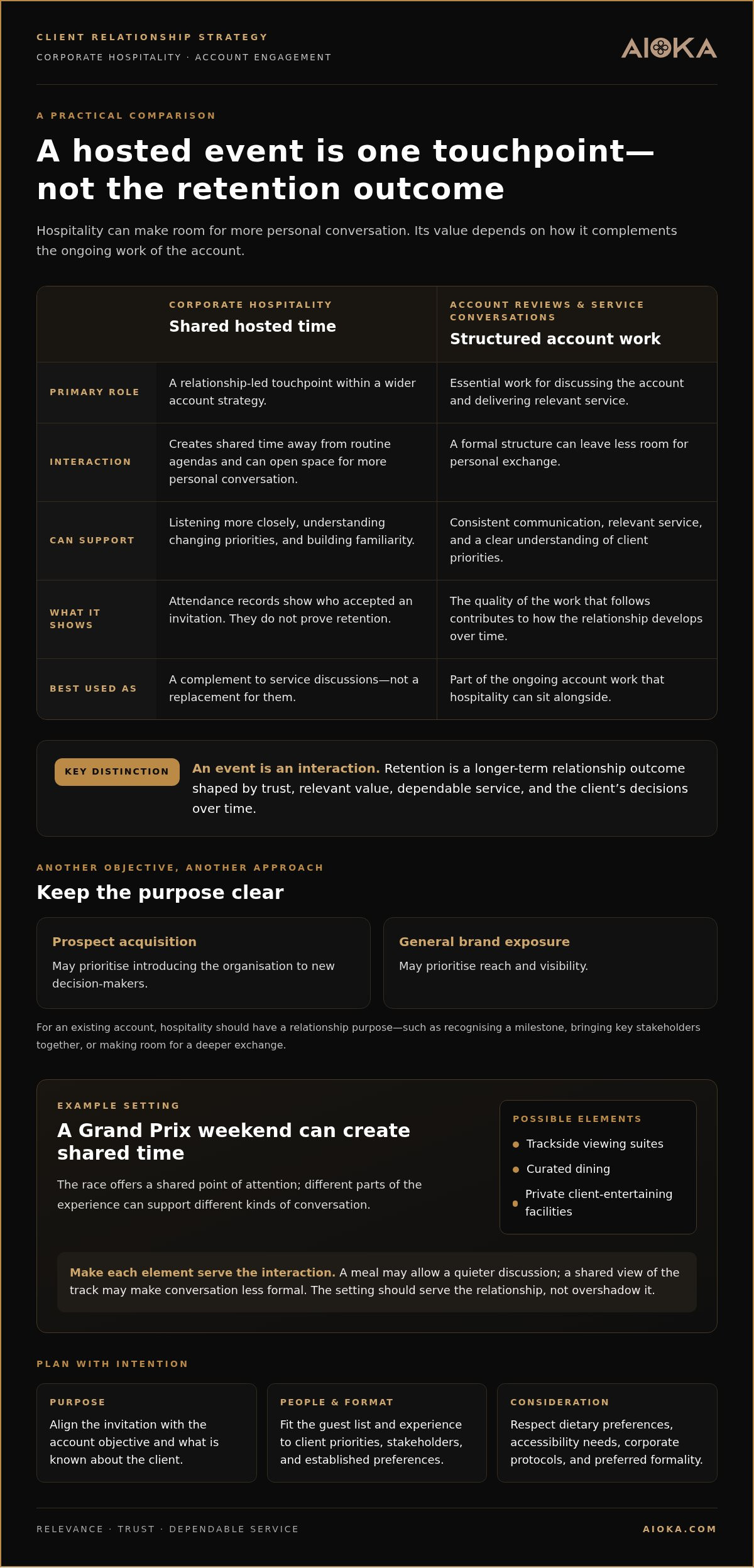
A hosted experience can give a client relationship a distinctive setting, but its significance depends on what surrounds it. Client retention through corporate hospitality means using deliberate, relationship-led hosting as one touchpoint within a wider account strategy, alongside relevant service, consistent communication and a clear understanding of the client’s priorities. An elegant occasion may open space for conversation; it cannot, on its own, establish that a client will stay.
A useful working definition is: “Client retention is the continued preference of an existing business client over time, supported by trust, relevant value and dependable service; attending an event is an interaction, not proof of retention.” This distinction matters commercially. Attendance records show who accepted an invitation. Retention is reflected in the relationship and the client’s decisions over time.
Retention as a relationship outcome, not an event outcome
Relationship marketing offers a useful lens. In their 1994 article in the Journal of Marketing, Robert M. Morgan and Shelby D. Hunt describe relationship marketing in terms of establishing, developing and maintaining successful relational exchanges. Applied to business accounts, this perspective places hospitality within an ongoing pattern of mutual value, rather than treating one occasion as the relationship itself.
A hosted event may give a client and account team unhurried time to exchange perspectives beyond the formal agenda. That conversation can help the team listen more closely, understand changing priorities and build familiarity. It does not show that hospitality caused a renewal or secured future work. A more credible measure is whether the relationship continues to develop through useful dialogue and dependable delivery after the gathering.
Where corporate hospitality can contribute
Hospitality is especially relevant when an established client relationship would benefit from considered recognition or shared in-person time. For example, a host might bring together the people responsible for a long-standing account over dinner, creating a more personal setting for conversation than a routine review. The aim is not to replace service discussions, but to complement them with attentive, human contact.
That objective differs from prospect acquisition, where the priority may be introducing an organisation to new decision-makers, and from general brand exposure, where reach and visibility take precedence. For an existing account, the invitation should reflect a relationship purpose: recognising a milestone, bringing key stakeholders together or making room for a deeper exchange. A Formula 1 weekend can provide one possible setting, with trackside viewing, curated dining and private entertaining facilities. Its suitability depends on the client, the account objective and the conversation the host hopes to facilitate.
Keep the distinction clear in planning and evaluation. A memorable event is an occasion; retention is a longer-term relationship outcome shaped by relevance, trust and the quality of the work that follows. Hospitality can contribute when it has a clear place in the account plan, but it should never be presented as a guarantee of loyalty or commercial return.
How Corporate Hospitality Can Strengthen Client Relationships
Account reviews and service conversations are essential, but their formal structure can leave little room for the personal exchange that helps people understand one another. A hosted experience can complement that work by creating shared time away from routine agendas. A client may raise a concern, describe a changing priority or connect with the people responsible for the relationship. The value lies in the quality of attention, not in assuming that time together automatically changes a client’s decisions.
Building relevance through considered personalisation
Personalisation starts with listening. Before shaping an invitation, align the guest list, hosting purpose and format with what the account team knows about the client’s priorities, senior stakeholders and established preferences. For example, if several decision-makers rarely meet in person, a shared occasion may be more useful than an elaborate gesture directed at one individual.
Thoughtful relevance is quieter than conspicuous display. Respect dietary preferences, accessibility needs, corporate protocols and the client’s preferred level of formality. Use reliable knowledge rather than assumptions. An invitation should feel connected to the relationship, not like a generic entertainment offer with the client’s name added.
Creating meaningful shared time at a Grand Prix
A Grand Prix weekend brings several possible settings together: trackside viewing suites, curated dining and private client-entertaining facilities. Moving between the circuit’s activity and a more private space can create natural moments for conversation, while the race gives hosts and guests a shared point of attention. These elements can make an occasion distinctive without dictating what the relationship must become.
For an account team, the practical question is how each part of the experience serves the intended interaction. A meal may allow a quieter discussion; a shared view of the track may make conversation less formal; a private setting may help bring several client stakeholders together. The host’s attentiveness still matters most. Access and prestige cannot replace knowing the account, listening closely or delivering well after the event.
Harvard Business School’s academic perspective on customer retention treats retention as something to define and measure over time, rather than infer from a single interaction. One hosted experience can create an opportunity for connection, but it cannot establish retention by itself.
To keep the experience anchored in the relationship, hosts can:
• Agree on a clear purpose with the account team before inviting guests.
• Use known preferences to shape the setting while leaving room for the client’s own choices.
• Note useful themes from conversations and carry them into appropriate account follow-up.
That continuity gives hospitality its place in a broader relationship programme. For teams considering a Grand Prix setting for existing clients, AIOKA’s Formula 1 hospitality brings trackside viewing, curated dining and private entertaining together around a considered hosting purpose.
Corporate Hospitality Compared with Other Client-Retention Approaches
Client relationships benefit from different kinds of attention, and each format serves a distinct purpose. Account reviews clarify progress and commitments; executive roundtables bring peers together to exchange perspectives; loyalty mechanisms recognise continued engagement; hospitality creates a more informal setting for an existing relationship. Choose the format by relationship need, not prestige alone.
| Approach | Relationship purpose | Interaction depth | Continuity | Evidence afterward |
|---|---|---|---|---|
| Corporate hospitality | Recognise an established client and make room for shared, less formal time. | Potentially personal, shaped by the guest list and setting. | Occasional touchpoint, strengthened by thoughtful follow-up. | Attendance, conversation themes and agreed next steps; not proof of retention. |
| Executive roundtable | Encourage peer exchange or explore shared sector perspectives. | Broad discussion across invited participants, with less individual focus. | Can recur as a forum for ongoing exchange. | Participation, themes raised and subsequent connections. |
| Account review | Assess delivery, priorities, decisions and service matters. | Focused and structured around the account. | Can follow an agreed review cadence. | Documented actions, decisions, responsibilities and progress. |
| Loyalty mechanism | Recognise continued engagement through a defined benefit or acknowledgement. | Often more transactional than conversational. | Typically linked to repeat activity or established criteria. | Recorded participation or benefit use, interpreted in context. |
Choosing between hosted experiences and ongoing account engagement
The table highlights an important distinction: hospitality is not a substitute for account management. Use a review when the relationship needs decisions, service discussion or a clear record of next steps. Choose a roundtable when clients may value exchanging perspectives with peers. A hosted experience is better suited to recognising an established relationship and letting conversation unfold beyond a formal agenda. These formats can complement each other, but none should obscure unresolved service needs.
Matching the format to the relationship objective
Consider the relationship’s maturity, the client’s current priorities, who should be present and what conversation the host hopes to make possible. Private entertaining may suit a focused exchange with a small group; shared hospitality may work better when several stakeholders or client organisations would benefit from a common setting. Neither format is inherently superior. Choose the one that respects guest needs and serves a clear account purpose.
For client retention through corporate hospitality, evaluate the experience alongside the account’s ongoing service and communication, not in isolation. A well-attended event is evidence of participation. More meaningful signals emerge afterward: whether useful conversations lead to appropriate action, whether the client’s priorities are addressed and whether the relationship continues to develop. This keeps hospitality in its proper role as one considered element of a broader retention approach.
Designing a Corporate Hospitality Programme for Client Retention
A purposeful programme starts with the account, not the event calendar. Each invitation needs a clear relationship objective, a considered guest list and a plan for what happens after the gathering. This sequence makes hospitality part of the account’s ongoing work, keeps its contribution proportionate and gives the team a sound basis for reviewing what followed.
Define the account objective.
Identify what would be useful for this relationship: recognising a significant partnership, bringing client stakeholders together or making room for an unhurried exchange. Keep the objective specific enough to guide decisions, without turning the occasion into a sales agenda.
Select the guests.
Invite people whose presence serves that purpose. Consider who shapes the relationship on both sides, who should be introduced and whether the format suits the group. A guest list assembled simply to fill places rarely creates the same coherence.
Curate the experience.
Match the setting, hosting style and event details to the account context and known preferences. Coordinate the host team in advance so guests are welcomed attentively and conversation has room to develop. For further hosting principles, consult “Formula 1 Client Entertainment: Guide for Business Hosts.”
Follow up personally.
Send a timely message that refers to a genuine moment or discussion from the occasion and connects it to a relevant client priority. If an action was agreed, ensure the appropriate account lead carries it forward through normal service and communication.
Review relationship signals.
Consider feedback and subsequent account conversations alongside relevant indicators, such as continued engagement, progress on shared priorities or changes in the relationship. Treat these as context, not proof that the event alone caused a particular outcome.
Before and during the event: align the guest experience
Before sending invitations, write down the objective for each priority relationship and share the relevant context with the hosts. Clarify who will welcome each guest, which introductions may be useful and what preferences or corporate protocols should shape the experience. During the event, hosts should stay present and responsive, letting conversation follow the client’s interests rather than pressing through a predetermined pitch.
After the event: sustain the relationship and assess signals
Follow-up should feel personal, not automated. Acknowledge the shared occasion, refer to a point that mattered to the client and continue any practical discussion through the usual account channel. Then compare subsequent engagement, feedback and account progress with the relationship’s broader history. A positive exchange may coincide with stronger engagement without proving the event caused it, so record what happened and avoid overstating the connection.
For teams developing client retention through corporate hospitality, a disciplined sequence connects the hosted moment with ongoing account stewardship. AIOKA’s Formula 1 hospitality experience can make the setting serve a defined client relationship objective.
AIOKA and Formula 1 Hospitality as a Considered Client-Retention Platform
A Formula 1 Grand Prix can give an established client relationship a distinctive setting, but its value begins before race weekend, with a clear understanding of the account and the purpose of hosting. AIOKA helps organisations translate those objectives into curated Grand Prix hospitality, shaping the environment and experience around the people invited and the relationship the host intends to nurture.
From account objective to a curated Grand Prix experience
The format, guest list and hosting environment should each reflect the account context. A focused group may call for a more private setting, while a wider client gathering may benefit from shared hospitality. AIOKA brings more than 15 years of experience securing trackside locations and curating brand activations, helping shape the experience around a considered hosting purpose rather than prestige alone.
AIOKA’s corporate hospitality packages include trackside viewing suites, curated culinary experiences and private client-entertaining facilities. These elements can support a host’s priorities, whether the aim is to give key stakeholders time to connect, recognise an established relationship or make room for conversation beyond the usual meeting structure. The event should complement attentive account management, not displace it.
Bringing global hospitality into a considered relationship programme
With access to Formula 1 races worldwide, AIOKA supports organisations hosting clients across markets. This can help a business plan client hospitality in different locations while allowing the setting and guest experience to reflect each account’s context. The race weekend provides the occasion; the purpose, hosting and follow-through give it meaning within the relationship.
For strategic buyers, weigh package considerations against the intended guest experience, hosting objectives and account context. The Formula 1 Corporate Hospitality Packages strategic buyer guide is a useful companion for assessing those considerations alongside the relationship programme. Trackside viewing, dining and private facilities are experience elements, not evidence of a particular commercial result.
That distinction is central to client retention through corporate hospitality. A curated Grand Prix experience can create an opportunity for meaningful shared time, while lasting client preference continues to depend on relevant value, trust and consistent service. No event can guarantee retention or revenue; its role is to support the wider relationship with care and intention.
To shape hospitality around your client relationships and business context, start a conversation with AIOKA about your account objectives, guest experience and preferred setting.
Shape the Next Client Moment with Intention
Bring hospitality into account planning early, while there is still time to align the occasion with the relationship’s wider direction. Consider which client moments merit a more personal setting, who should be part of the conversation and what the account team hopes to understand better. This turns hosting from a calendar decision into a considered choice about how the relationship should develop.
For leaders refining client retention through corporate hospitality, thoughtful planning is not measured simply by whether an event feels exceptional. It’s measured by whether the experience reflects the client relationship with discernment and gives the team a stronger basis for its next interaction. Let the occasion open a new chapter, while the relationship continues to be earned through the work that follows.
Talk with AIOKA about a Formula 1 corporate hospitality experience shaped around the clients who matter to your organisation. Start with a clear purpose.
Frequently Asked Questions
How do you calculate client retention rate?
Calculate retention over a defined period by subtracting new clients gained during that period from the number of clients at the end, dividing the result by the number at the start, then multiplying by 100. Decide consistently how to classify paused, merged or reactivated accounts, and count newly acquired clients separately from retained ones. The rate measures account continuity, not event attendance or satisfaction. Interpret changes alongside account history rather than crediting one hosted occasion.
How soon should a business follow up after corporate hospitality?
Follow up while the shared experience is still fresh, with timing guided by the conversation and any agreed next step. A personal note within a few working days is often a useful practical aim; act sooner if you promised information or an introduction. Refer to a specific moment or client interest rather than sending a generic sales message. The note should continue the relationship, not replace regular account communication or dependable service.
Who should a company invite to a client hospitality event?
Invite people whose presence supports the purpose of the gathering and reflects how the account works. This may include the relationship owner, relevant client decision-makers and colleagues directly involved in a shared priority. Seniority can matter, but it shouldn’t be the only measure of who belongs. Consider the client’s interests, guest mix and corporate protocols, and avoid treating the invitation list as a prospecting database. A balanced group makes conversation more natural and relevant.
Can corporate hospitality help retain clients without a loyalty programme?
Yes. A formal loyalty programme isn’t a prerequisite for client retention through corporate hospitality because the two approaches serve different functions. A hosted occasion can recognise a relationship or create a setting for conversation without attaching a points system or recurring reward. Retention still rests on the wider value and consistency of the account relationship. Choose the approach that fits client needs, then assess feedback, engagement and account developments over time rather than relying on one signal.
What happens if clients do not respond after a hospitality event?
Silence after an event doesn’t, by itself, mean the client rejected the invitation or found the occasion unsuccessful. Consider the account context and the client’s usual communication style, then follow through on any promised action with a useful, relevant message. Avoid repeated notes that refer only to the event. If the client later shares feedback, consider whether the invitation and format matched the relationship’s needs, and adjust future hosting accordingly.
Is corporate hospitality appropriate for every client relationship?
No. Suitability depends on the client’s preferences, the relationship’s context, relevant organisational protocols and the purpose of the interaction. For a client focused on resolving a service issue, a direct account conversation may be more appropriate; another client may value an informal hosted setting. Treat hospitality as one option in a wider relationship plan, not a default gesture. Thoughtful selection and relevance matter more than choosing the most prestigious experience.


