
5 Ways to Close Deals with Corporate Hospitality Through Better Offers
Five practical ways to shape hospitality offers, from personalised experiences to transparent pricing, that help move client conversations forward.

Prestige may open the conversation, but a considered offer moves it forward. Closing deals with corporate hospitality depends on five practical choices: personalize the experience, add meaningful non-monetary value, tailor the proposal to the buyer’s priorities, follow up thoughtfully, and present pricing transparently. Together, these choices make the business case clearer while preserving the distinction and discretion that high-level client relationships require.
A memorable setting matters, but decision-makers also need to understand how the experience serves their guests, brand, and objectives. This guide explains how to shape an offer around those priorities, negotiate constructively, and make the next step clear without pressure or vague promises. From the first conversation to the final proposal, thoughtful details can make hospitality not only impressive, but relevant to the relationship you want to build.
Key Takeaways
• Shape each offer around the prospect’s business objectives and the experience they want their guests to remember.
• Consider thoughtful non-monetary additions that enhance the occasion without relying solely on discounts.
• Refine proposals around the buyer’s priorities, making any trade-offs clear and purposeful.
• Use attentive follow-up to keep the decision moving while respecting the prospect’s timing.
• Present pricing and inclusions plainly so decision-makers can assess the offer with confidence.
1. Personalized hospitality messaging
Effective corporate hospitality gives clients a shared experience suited to their interests. A hosted culinary event, a major sporting occasion, or an invitation-only brand experience can create space for meaningful business conversation. The right choice depends on the relationship, guests’ preferences, and the purpose of the meeting.
Unlike broad advertising or cold outreach, hospitality creates direct time with prospective clients. It gives sales teams an opportunity to listen, build rapport, and understand decision-makers’ priorities in person. It complements other B2B acquisition strategies rather than replacing them, since a memorable event still needs relevant outreach and considered follow-up.
Choose venues and experiences based on the industry, desired atmosphere, and available budget. A technology firm, for example, might value a focused product discussion, while an established client may prefer an elegant culinary experience or a luxury performance concept like Catwalk Opera. A smaller gathering can suit a close account; a larger event can support broader relationship-building.
In the United States, manage corporate gifts and entertainment through clear records and internal policies. Document the business purpose, attendees, agenda, and hosted elements, then route the details through finance or compliance for appropriate tax treatment. Hospitality connected to a business discussion should be recorded separately from a personal gift.
To plan an event that advances a prospect relationship, start with one business objective, such as arranging a follow-up meeting. Invite relevant decision-makers, tailor the experience to their stated interests, and create a natural opportunity to discuss shared priorities. A clear next step gives the gathering commercial direction without making it feel like a sales presentation.
Before hosting, confirm the guest list, preferences, event details, and conversation goals. During the event, listen closely and make introductions that connect guests with relevant colleagues. Afterward, send a personal note that refers to a specific discussion and proposes a useful next step, such as sharing a tailored proposal.
Hospitality can create a conflict of interest if guests perceive it as pressure to influence a purchasing decision. Respect each organization’s gift and entertainment policies, avoid linking an invitation to a contract decision, and keep the business purpose transparent. If a prospect’s policy restricts hosted events, choose a more suitable form of engagement.
Personalized messaging begins with a specific question about the prospect’s event priorities, followed by time to listen. Then connect the offer to their stated concern, whether it is VIP treatment, event setup, or guest logistics. A boutique hotel in Brisbane increased cold-call-to-booking conversion by 30% within its first quarter using personalized interactions and follow-up.
A short, tailored video can make an event proposal easier to picture. Show how the venue could be arranged for the prospect’s gathering, and connect the visuals to their goals. Follow up with a scheduled email or call that refers to the video and one detail from the conversation; eProposal data indicates 70% of customers choose the first proposal they receive.
2. Adding value through non-monetary perks
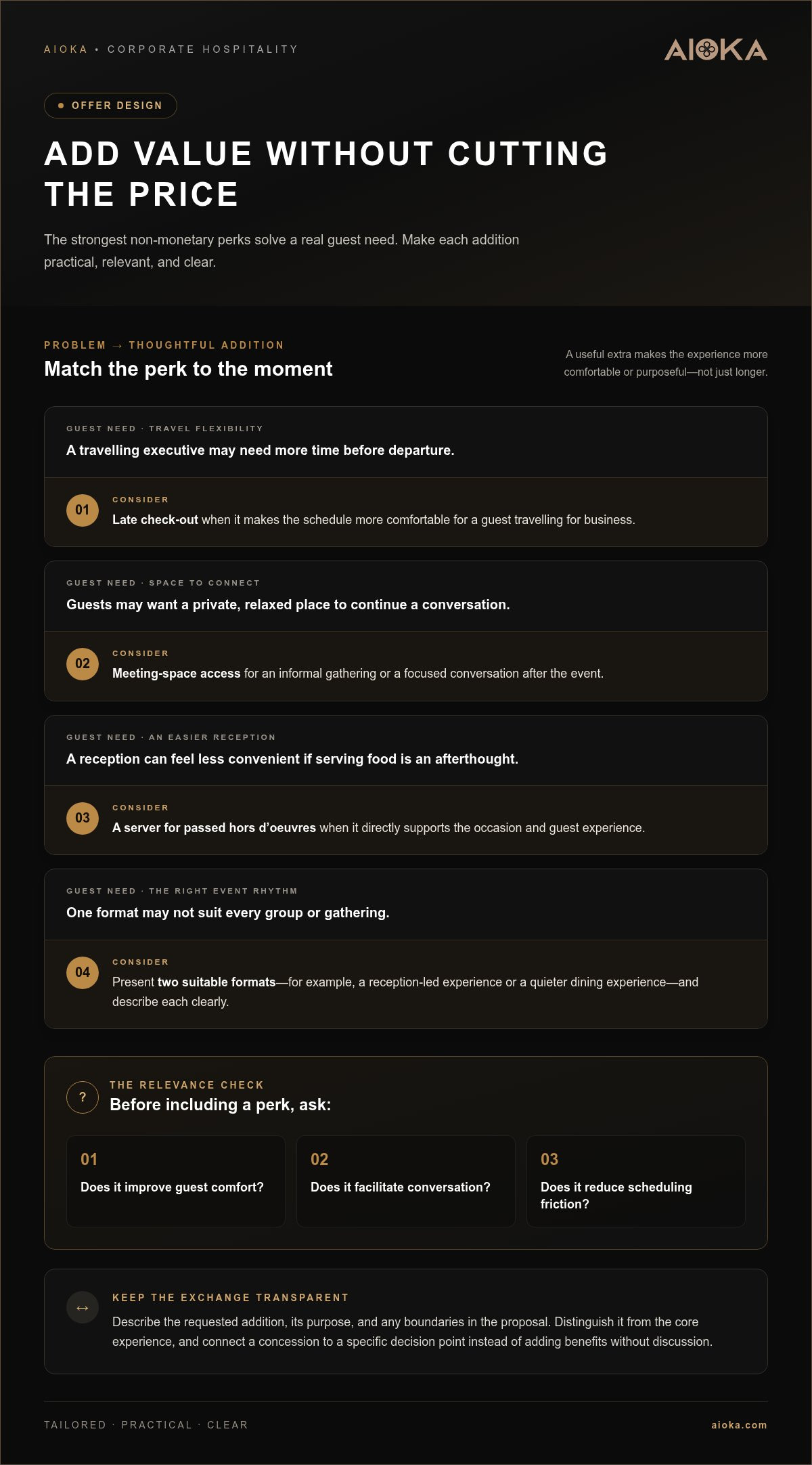
A proposal can offer more value without a lower price when its details address guests’ practical needs. A hotel might include a server for passed hors d’oeuvres, late check-out, or meeting-space access for an informal gathering. Each addition should make the event more comfortable or useful, rather than simply lengthening the list of inclusions.
Start by identifying what would improve the prospect’s experience. Ask whether guests need time to meet privately, a more considered welcome, or flexibility around departure. Late check-out may matter to a travelling executive, while a quiet meeting space could support a focused conversation after the formal event. The most persuasive perk solves a real inconvenience.
Match each concession to the occasion and explain its relevance. For an opening reception, a sales representative might include requested hors d’oeuvres at no extra charge. For an event running late, access to a meeting room could give attendees a relaxed place to continue conversations. These additions have value because they support the event’s purpose, not because they are presented as extravagant gifts.
Choice can also make an offer easier to evaluate. Rather than presenting a single hospitality arrangement, frame two suitable options around different guest preferences. For example, a restaurant host might offer a reservation at 6:30 or 7:30. In a corporate proposal, the equivalent could be a reception-led format or a quieter dining experience, each clearly described.
Before including a perk, ask whether it improves guest comfort, facilitates conversation, or reduces scheduling friction. Coworking space, fast-lane check-in, or a networking gathering may suit business travellers. A personal welcome or a carefully chosen culinary detail may better suit a smaller client event. Let relevance guide the selection.
Keep the value exchange transparent during negotiations. Describe the requested addition, its purpose, and any boundaries in the proposal, and distinguish it from the core experience. If a prospect asks for a concession, connect it to a specific decision point instead of adding benefits without discussion. This keeps expectations clear and preserves the integrity of the offer.
Non-monetary additions work best when they are tailored, practical, and easy to understand. Consider how thoughtfully designed hospitality experiences can make an event feel more considered, while keeping every detail aligned with the relationship and occasion.
The same principle applies beyond event-day hospitality. Hospitality sales representatives can offer non-monetary perks, such as a server for passed hors d'oeuvres, late check-out, or meeting-space access for a late-night pizza party, to add value to an event proposal. Hotel corporate sales pages can highlight discounts, perks, upgrades, and loyalty points as contract benefits. Presenting these options clearly helps clients compare the overall experience and keeps the discussion focused on practical benefits, not an unstructured collection of extras.
Consulting agreements can also use service as a considered concession. Hospitality consultants can offer travel days at no charge as a concession in a consulting agreement. Hospitality consultants can offer up to 3 hours of pro bono assistance after a project to review progress and support implementation. Set out what the assistance covers and when it is available, so the client understands how the added support fits the engagement. A well-defined benefit can strengthen the relationship while keeping expectations clear.
3. Adjusting proposals during negotiations
Strong negotiation begins with the prospect’s priorities, not a prewritten package. Summarize the discussion in a concise document decision-makers can review together. Include the event’s purpose, guest profile, preferred format, and essential requirements. A company hosting senior clients, for example, may value a private reception more than additional event features. This approach supports closing deals with corporate hospitality by making the buyer’s decision easier to assess.
Reflect those priorities in the proposal. If the prospect emphasized budget, food choices, and room types, address each point directly instead of sending a generic revision. A clear structure helps buyers compare options and gives internal stakeholders a practical account of the choices and the reasoning behind them.
When a prospect requests a discount or additional service, clarify the condition attached to the request. If approval is possible, ask whether granting it would lead to a signed agreement. This makes the discussion specific: the seller understands what could move the decision, and the buyer can respond to a defined offer.
A lower price may require an adjustment to the experience. Removing a cocktail hour, for instance, may preserve the central event while bringing the proposal closer to the buyer’s budget. Explain the change plainly, including its effect on the guest experience, so the prospect can assess the trade-off upfront.
Small, relevant concessions can help close a deal when the main terms are already acceptable. A requested boardroom at no extra charge, an additional complimentary room, or a suite upgrade may address a remaining concern. Treat each as a deliberate adjustment, not an open invitation to add more concessions without an agreed decision.
For a buyer comparing alternatives, a one-time personalized offer can provide a focused path forward. Explain what has been tailored and why it fits the prospect’s stated needs. Avoid artificial urgency. If a genuine deadline affects the offer, state the reason and date clearly, then give the buyer time to evaluate the terms.
Bring a manager into the conversation when a key account needs additional authority or a decision-maker’s concern calls for senior attention. The manager should add useful context, such as explaining how the revised event supports the prospect’s objectives. Their involvement works best after the sales representative has summarized the discussion and proposed a clear next step.
Before sending a revision, compare it with the previous version and identify every material change. Confirm the agreed format, inclusions, exclusions, and decision point in writing. In closing deals with corporate hospitality, a precise proposal keeps negotiation focused on fit and value, gives the buyer a clear basis for approval, and ensures the sales team understands what comes next.
4. Monitoring buyer engagement and follow-up
After guests leave, useful signals may include a proposal view, an email reply, or a request for another conversation. Record each interaction in the customer relationship management system (CRM), linked to the event and relevant account. This gives the sales team a consistent record instead of relying on a host’s memory or scattered inboxes.
Measure leads, pipeline, and deals by recording invited and attending prospects, qualified opportunities, proposal progress, and resulting revenue in the CRM. Link each opportunity to its event source, then distinguish deals generated by the event from existing opportunities it influenced.
Base follow-up on observable engagement. Alerts for proposal views, email opens, or relevant website visits can prompt a timely response. An alert is a cue to review the account, not a reason to assume the prospect is ready to buy. A viewed proposal might call for a concise clarification, while a detailed reply may warrant a conversation about decision criteria.
Use a consistent event record so the team can track progress across accounts. Include:
• The event name and date, with the host and attending prospects.
• Each prospect’s organization, role, and stated business interest.
• The next action, its owner, and the prospect’s decision stage.
• Whether the opportunity is new, active, advanced, paused, or closed.
These fields make handoffs more precise. A colleague taking over an account, for example, can see that a guest requested a tailored proposal instead of sending a generic introduction. Clear ownership also prevents two representatives from approaching the same buyer with conflicting messages.
After the event, compare attendance with qualified leads and subsequent opportunities. Review which conversations progressed, which stalled, and whether a particular event format attracted the intended decision-makers. Revenue matters, but consider it alongside pipeline movement and relationship development, since a long-cycle account may advance before producing a closed deal.
Keep follow-up connected to the conversation. If a prospect asked about hosting senior clients, share a relevant proposal detail; if they raised scheduling concerns, address those directly. Record the response and update the next action in the CRM so future communication reflects the buyer’s actual interests.
Review event-sourced opportunities with sales and marketing together. Compare account notes, campaign records, and deal status, then identify where prospects disengaged or advanced. This shared review helps teams refine invitations, event design, and post-event communication without treating every interaction as immediate revenue.
For a hospitality program, Corporate Hospitality Packages can be assessed through the same disciplined process: connect each event to its invited accounts, documented conversations, and resulting pipeline activity.
Alerts for proposal views, email opens, and website visits can help hotel sales teams follow up promptly with prospective group-business clients. Treat each signal as a reason to review the account record and choose a response that fits the buyer’s expressed interest, not as proof that the prospect is ready to buy. Utilizing sales intelligence platforms or remote support from providers such as Jacaruso Enterprises can help teams manage follow-ups efficiently, moving next steps forward while keeping communication relevant to the prospect and the conversation.
5. Transparent pricing and honest selling
Clear pricing helps decision-makers assess an opportunity without guessing what the proposal includes. Present the scope, inclusions, exclusions, and relevant cost factors together. For example, distinguish the hosted experience from optional additions so finance and event teams can evaluate the same offer. The commercial terms should be presented with the same care as the occasion itself.
For bespoke hospitality, pricing depends on the event and is provided after a quote request. Factors include the format, location, duration, guest requirements, and selected experiences. Explain how each shapes the proposal instead of implying that every client receives the same package. This gives buyers a clearer basis for internal review.
Use a consistent proposal structure. State what the offer covers, what can be tailored, and which decisions remain open. If a prospect requests a change, such as a different culinary format or revised event schedule, show how it affects the scope. Clear revisions help prevent misunderstandings between the buyer, host, and finance team.
Honest selling also means describing the experience accurately. If a proposal includes a hosted reception and a private discussion, state both plainly. Do not imply that the event guarantees a contract, exclusive access, or a particular business result. Buyers should understand the experience and its commercial purpose before deciding.
Trust has commercial value: nearly half of consumers were willing to spend more for brands they trusted. In a corporate proposal, consistent terms, prompt answers, and a clear account of what the buyer receives help build trust. If an element changes during negotiation, update the document rather than relying on a verbal understanding.
Before presenting terms, review them from the buyer’s perspective. Can a decision-maker identify the total scope, understand the main cost factors, and explain the offer internally? A concise summary, for example, can separate core hospitality from optional enhancements. That clarity supports sound approval and keeps discussion focused on fit rather than unexpected details.
Transparent pricing does not require a sales team to reduce every proposal to cost alone. Explain how the setting, guest experience, and business objective relate to the investment, while respecting the buyer’s budget and approval process. If a requested adjustment changes the offer, document the revised scope and terms together.
For a tailored proposal with clearly presented scope and pricing, request a hospitality quote.
AIOKA: Corporate Hospitality Packages
AIOKA is a natural next step for businesses planning client hospitality at Formula 1 race weekends. Its Corporate Hospitality Packages bring together premium hosting, trackside settings, and curated culinary experiences, while Brand Activation Services support brands seeking a considered presence around the event.
Turn to AIOKA when your proposal calls for more than an invitation: a setting that can welcome clients, support business conversations, and align the occasion with your brand. The experience can be shaped around your guests and event objectives, with clear attention to the hospitality and activation elements that matter most.
To discuss your corporate hospitality plans, visit aioka.com.
Shape the Next Client Conversation
The next opportunity begins with deciding what kind of relationship you want the experience to make possible. Treat hospitality as a deliberate setting for meaningful exchange, aligning the invitation, atmosphere, and conversation with the connection you hope to build. That perspective keeps closing deals with corporate hospitality grounded in thoughtful business development, not spectacle alone.
For organizations planning that experience around a Formula 1 weekend, AIOKA offers Corporate Hospitality Packages, Brand Activation Services, and Curated Culinary Experiences. Each can contribute to a considered occasion shaped around your guests and commercial intent.
Bring your objectives and the experience you have in mind into the next conversation. Contact AIOKA to discuss your hospitality plans, and take a considered step toward your next client relationship.
Frequently Asked Questions
How does corporate hospitality help close business deals?
Corporate hospitality creates a shared setting where prospective partners can speak beyond the formality of a scheduled sales meeting. A hosted experience, such as entertaining a potential business partner during a Formula 1 weekend, gives both parties time to explore interests and working styles. Use that time to understand how the organizations might collaborate, then agree on a specific business discussion as the next step. The hospitality supports the relationship; the commercial decision remains grounded in business value.


